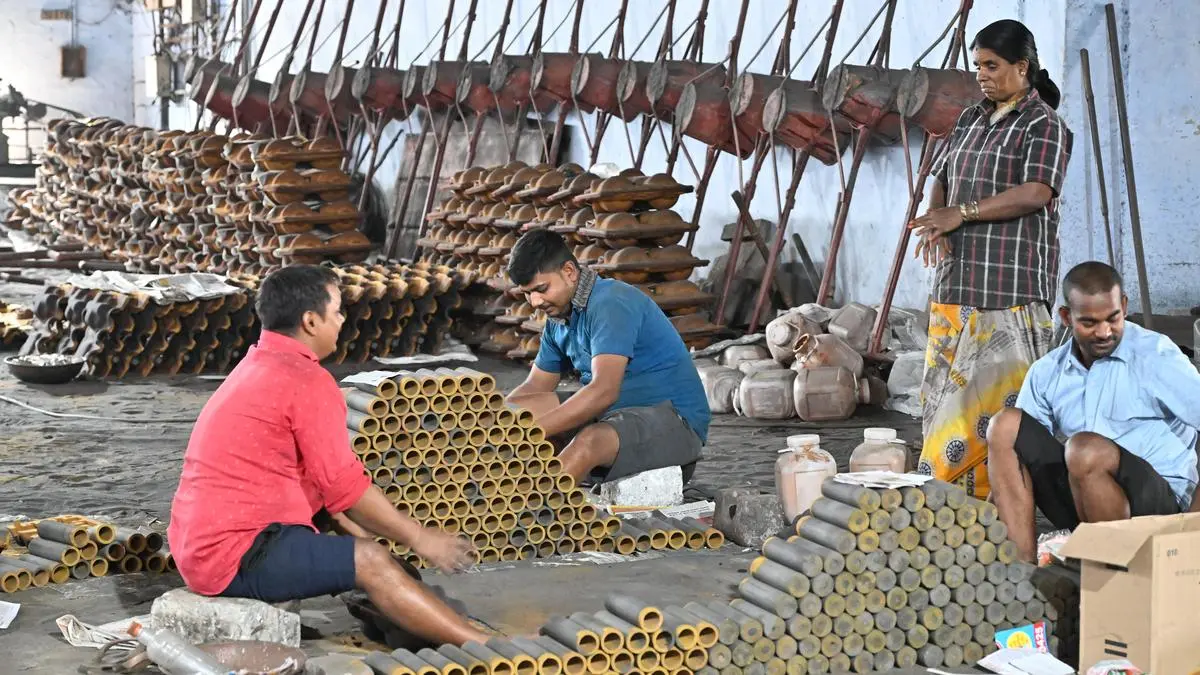

A populous young workforce can fuel growth if well-educated
| Photo Credit:
SIVA SARAVANAN S
India is now the world’s most populous country, with an estimated population of about 1.46 billion people as of mid-2025. Is population a boon or a bane for India?
Thomas Robert Malthus argued in his 1798 essay that population grows geometrically, while resources — especially food — grow arithmetically. This mismatch inevitably leads to checks like famine, disease, and conflict that curb population growth.
In India’s case, the population has soared from 361 million in 1951 to over 1.4 billion by 2025, putting tremendous pressure on finite natural resources. Despite the Green Revolution avoiding outright famine, environmental degradation, groundwater depletion, and regional food shortages persist — a sign of Malthusian risk. Although fertility has declined (TFR is 2.0, slightly below replacement), the sheer scale of population continues to strain services and infrastructure.
According to Malthusian theory, unregulated expansion causes misery unless it is managed, and a population that lacks adaptive innovation becomes a burden. If resources and people grew simultaneously, population growth would not be an issue. This has been further explained by Charles Darwin as “Struggle for Existence”. Evolution is driven over time by variation, adaptation, and unequal reproductive success. Darwin himself was influenced by Malthus, who believed that species are shaped by the fight for survival driven by population pressure.
A populous young workforce can fuel growth if well-educated and employed — a potential demographic dividend. Competitive pressures may motivate innovation, productivity improvements, and collective adaptation. Yet without equitable access to education, healthcare, and jobs, natural potential can go unrealised.
Many struggles
Traditionally applied to natural resources like oil and minerals, the Paradox of Plenty refers to countries rich in resources but often plagued by poor governance, underdevelopment, and inequality. Now consider applying this to human capital of India. Despite having the largest youth population in the world, India struggles with high unemployment and underemployment, poor education outcomes (learning poverty, dropouts) inadequate healthcare access and regional and gender disparities. This is another kind of paradox of plenty.
Nobel Laureate Amartya Sen redefined development not merely as GDP growth but as enhancing people’s capabilities—their real freedoms to live the kind of life they value.
So, while Darwinian survival-of-the-fittest emphasizes adaptation through struggle, Sen’s approach advocates enabling everyone to flourish, not just those who can outcompete others. It’s not about who survives — it’s about who thrives, and how equitably. All these converge on one point: Population is potential — but only if nurtured into capability.
Since independence, India’s policymakers have emphasised higher education institutions (HEIs) — IITs, IIMs, AIIMS — gaining global acclaim. However, primary education received comparatively little focus. Basic literacy and numeracy remain low in many States. According to the ASER reports, large percentages of Class 5 students cannot read Class 2-level texts or solve basic arithmetic. Foundational initiatives like Sarva Shiksha Abhiyan, RTE Act, and NIPUN Bharat came late and still face uneven implementation.
Without a strong base, higher education becomes a fragile tower — resulting in graduates who are unprepared for the job market. Without foundational investment in capability, the country risks remaining stuck in the Paradox of Plenty — a youth-rich but skill-poor economy.
The writer is Assistant Professor, Dept of Economics, BR Ambedkar College, University of Delhi
Published on August 1, 2025
About the Author