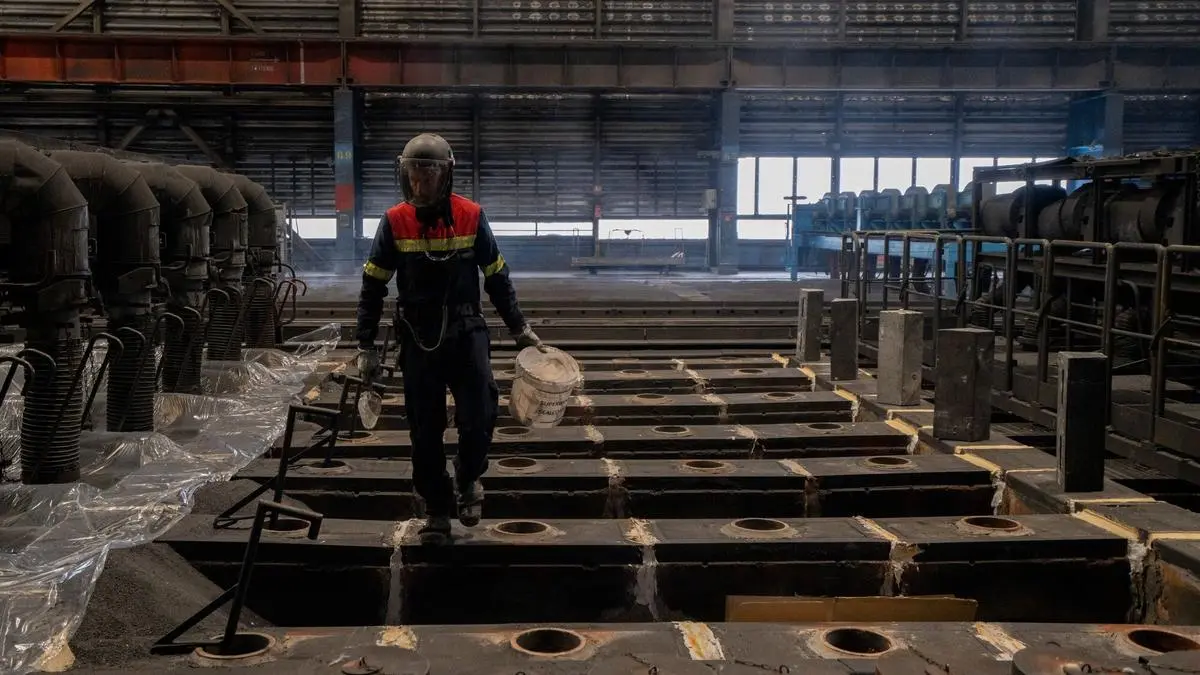

Eligibility is restricted to plants commissioned on or before March 31, 2025.
| Photo Credit:
Nathan Laine
To accelerate the decarbonisation of its steel industry, India is preparing a new policy roadmap that will offer financial incentives to steelmakers who can prove they have cut carbon emissions.
pThis first-of-its-kind initiative aims to safeguard the nation’s $25-billion steel export market against new carbon tariffs from the European Union. Unlike traditional subsidies, this new framework will only reward companies that show verifiable improvements in their emission intensity year over year.
The initial plans show, for every 0.1 tonne reduction in CO₂ per tonne of iron or steel produced, mills will earn ₹100, with an annual cap (upper limit) of ₹1,000 per tonne. No payment will be made in years when emission intensity fails to improve, as per preliminary documents reviewed by businessline.
Eyeing benefits
The move comes amid industry — both integrated and secondary steel-makers — seeking some “benefits” from the Centre if they are to switch to greener steel-making solutions.
Eligibility is restricted to plants commissioned on or before March 31, 2025. All reported emissions data will be independently verified by BEE-accredited auditors (Bureau of Energy Efficiency) and authenticated by the National Institute of Secondary Steel Technology.
Any manipulation of data will lead to disqualification and recovery of funds.
Average carbon dioxide (CO2) emission (in terms of tonnes per tonne of crude steel produced) in India is currently around 2.5 T/tcs (reduction from 2.65 T/tcs in 2015). The global averages stand at around 1.85 to 1.92 T/tcs (World Steel Association numbers) or 1.4 T/tcs (IEA estimates).
Time Frame
The scheme details will run from FY27-FY31 and is expected cover 60 million tonnes (mt) of “sustainable steel”.
India’s crude steel output stood at 152 mt in FY25, making it the world’s second-largest producer, yet per capita consumption remains at 108 kg.
The sector is also responsible for roughly 12 per cent of the country’s total carbon dioxide emissions.
In December, India defined green steel. The threshold was metal produced with CO2 emissions of less than 2.2 tonnes per tonne of finished steel (t-CO2/tfs). A star rating system was introduced. Steel with emission intensity higher than 2.2 t-CO2e/tfs shall not be eligible for green rating.
Stark Challenge
Much of the industry runs on low-grade coal and iron ore, lowering efficiency and raising environmental impact.
Forty-four per cent of secondary steel is produced via coal-based direct reduced iron, one of the most polluting methods.
Horizontal rotary kilns limit the adoption of cleaner hydrogen or gas-based alternatives, while scrap shortages restrict the growth of electric arc and induction furnaces, which are far less carbon-intensive. Limited access to natural gas further impedes the shift away from coal.
To address these disparities, the proposal is set to come up with stringent alloy-making route-wise emission benchmarks.
Published on August 14, 2025
About the Author