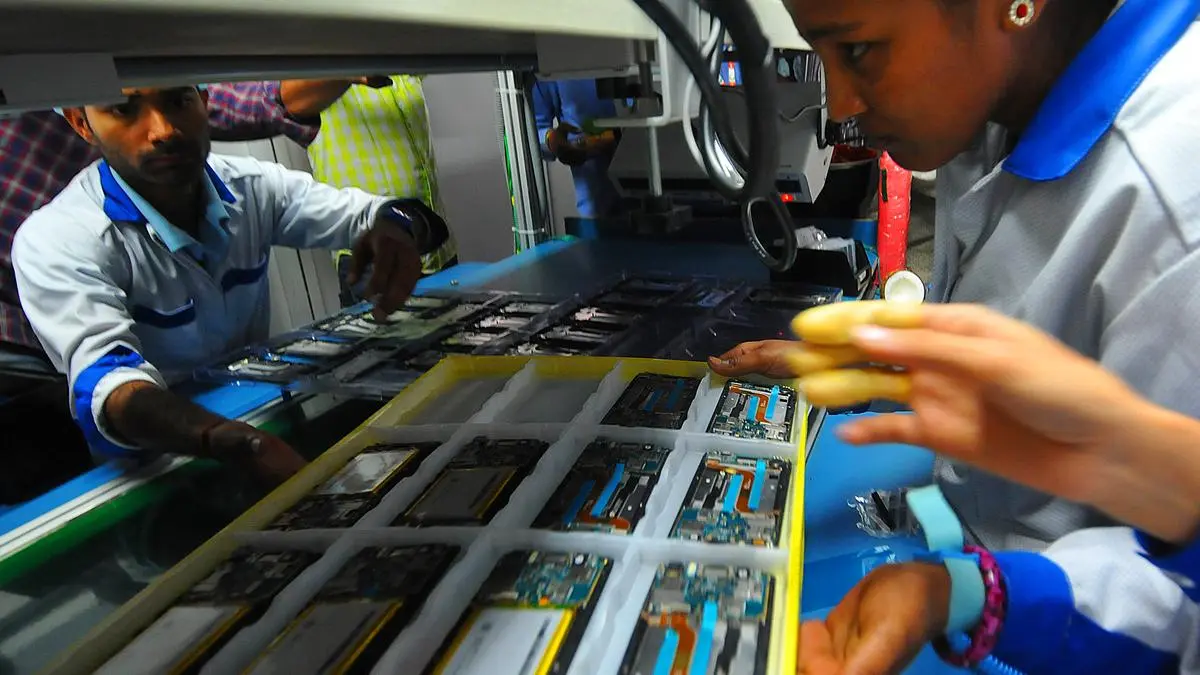

Since the implementation of the PLI, the production of smartphones has more than doubled
| Photo Credit:
MOHAMMED YOUSUF
The origin of India’s PLI for smartphones can be traced to three developments. First, the trade war on China by President Trump in his first term fuelled a search by global MNCs for alternative production destinations. Second, the National Policy on Electronics, 2019 set ambitious targets for production and exports of mobile handsets. Third, the ruling of the WTO panel that India’s MEIS (Merchandise Exports from India Scheme) was inconsistent with WTO norms. This led to a search for alternatives which were WTO consistent.
In 2019, the then Principal Secretary to the Prime Minister, Nripendra Misra set up a high-level committee under Amitabh Kant, NITI Aayog CEO, which, after extensive consultations and analysis, developed a PLI scheme for electronics and smartphones — Large Scale Electronics Manufacturing.
Financial support under Smartphone PLI is 4-6 per cent of incremental sales, subject to specified thresholds for incremental investment and sales being met. Following the initial PLI schemes, 11 other PLI schemes were announced. Of all these, Smartphone PLI has been most successful.
Since the implementation of the PLI, the production of smartphones more than doubled, and the share of exports to domestic production increased from 11 per cent to about 40 per cent. In 2024-25, mobile phones ranked first amongst all merchandise exports of India. India’s share in world smartphone exports tripled in the past three years. With continued support, Indian smartphone exports could overtake Vietnam’s (second largest global exporter) in the near future.
Investment commitment
These achievements are underpinned by strong investment commitments that continue into the next few years. This investment momentum needs to be continued. Now, production far exceeds domestic demand. Hence exports must continue to grow, which will depend on cost-competitiveness, i.e., include support that reduces disabilities.
The Government is reviewing the PLI schemes. Such a review should differentiate between the high performing PLIs and others. Different strategies would be relevant for the two groups. For the high performers, it is important to take account of the prevailing situation and factors and accordingly provide support.
Consider the disabilities first. Estimates suggest that India still faces about 9 per cent disability (cost of land, credit, taxes, infrastructure deficits, logistics, high operational costs, and tariffs) vis-à-vis Vietnam. China has begun restricting availability of key inputs, equipment, personnel and technology in the supply chain. Some estimates suggest that these restrictions could increase costs by 3-4x. Thus, India needs to develop its domestic ecosystem and the process of consolidating production of different parts of the supply chain. This requires sustained growth of the smartphone sector.
India’s main competitors, China and Vietnam, are offering company-specific schemes. China’s overcapacity and its deep pockets make is impossible for India to win in a price war. Its companies, such as Luxshare-ICT, supported by opaque government subsidies, have overtaken their American and Taiwanese counterparts in competitive manufacturing. China will put export controls even on its own companies if they start building capacity in India for exports. China will not allow India to become a manufacturing hub for smartphones. Meanwhile, the tariffs for India announced by Trump pose another major challenge.
If India aims to be a global electronics manufacturing powerhouse, exports of smartphones should reach 30-40 per cent of the global exports. Given the current challenges to growth as well as existing disabilities, the PLI needs to be continued for this sector until the industry matures and helps build significant parts of its ecosystem.
Singh is former Deputy Director-General WTO, and Jha is former Head, UNCTAD India Office
Published on August 15, 2025
About the Author