
Over the past years, photography has been my main passion on gottapics.com. Recently, however, I discovered a new and equally fascinating hobby – gem faceting. The process of taking a rough crystal and transforming it into a sparkling, faceted gemstone is both challenging and deeply rewarding. Today, I want to share the story of my very first three faceted gemstones, the tools I used, and why this has quickly become an obsession.
The Tools I Use for Faceting
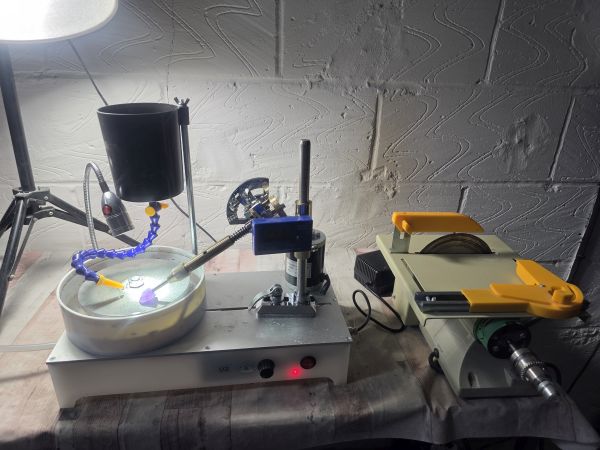
Before diving into the gems themselves, let’s talk about the machines. As a beginner, I didn’t want to spend thousands on professional machines like the Ultra Tec or Facetron. Instead, I found a surprisingly capable faceting machine on Amazon:
JMbpkduHs Gemstone Faceting Machine on Amazon
This machine turned out to be much better than I expected. For a fraction of the price (20x cheaper than the high-end models), it delivered the precision and stability I needed to cut my very first stones. The mast is stable, the angle adjustments are accurate enough, and with some patience, you can achieve results that look far beyond “beginner level.”
For preforming and trimming rough material, I use another Amazon tool:
Hocomay Gemstone Cutting Machine with Diamond Disc
This little saw works great for cutting quartz, agates, and other rough material into manageable pieces. It’s compact and easy to set up – perfect for someone like me just starting out.
Both machines together make a very affordable entry point into faceting, and as you’ll see below, the results speak for themselves.
My First Faceted Gemstones
Lithium Quartz – The Unexpected Free Form
The very first gemstone I attempted was a lithium quartz – brownish type of quartz. I started with the idea of cutting a standard brilliant pavilion. However, during cutting, I encountered a crack running through the stone. Rather than giving up, I improvised: I converted what was supposed to be the pavilion into the crown, then recut a new pavilion at 60 degrees to remove the crack.


The result was a free form gemstone – not a standard cut, but unique, with clean facets and a bright look. This experience taught me an important lesson: gem cutting is as much about adapting as it is about following diagrams.
Clear Quartz – Playing with 50 Facets
My second stone was a clear quartz. This time, I wanted to experiment more freely, without sticking too closely to a diagram. I ended up cutting around 50 facets, creating a stone that resembles a standard brilliant but with my own twists.


This gemstone has a lively brilliance, and even though it is another free form, I’m very happy with the result. Cutting quartz can be a challenge because it’s prone to scratches and polishing issues, but with patience, the Amazon faceting machine handled it surprisingly well.
Smoky Quartz – A Modified Sapphire Cut
For my third stone, I worked on a smoky quartz. I started with a small sapphire cut design but decided to experiment further. Instead of the usual 8 pavilion facets, I doubled them to 16, creating more reflections and complexity. I also introduced a broken pattern around the girdle, adding character to the stone.


This smoky quartz is probably my favourite so far. It feels like the moment when my hands and the machine started working together naturally.
Reflections on the Hobby
Faceting gemstones is not just about creating something beautiful – it’s about patience, precision, and creativity. What excites me the most is the freedom to adapt and experiment. Even with entry-level equipment, it’s possible to create gemstones that sparkle and capture light in amazing ways.
Looking back at my first three stones, I’m proud of the journey. From the lithium quartz that forced me to improvise, to the clear quartz experiment with 50 facets, and finally the smoky quartz with its modified sapphire cut, each gem carries a story.
I want to mention that I bought these crystals from Magic Willow in Liverpool

If you’ve ever considered trying gem faceting, I wholeheartedly encourage you to start. You don’t need a $5,000 Ultra Tec to dive in—an affordable, reliable entry-level faceting machine, paired with a small diamond disc saw, is all you need to begin creating beautiful gemstones. For me, faceting has grown from a hobby into a passion, much like photography, offering endless opportunities for creativity and expression.
Conclusion
Along the way, I’ve found a few essential tools and accessories that make a big difference for beginners: diamond faceting laps in multiple grits for shaping and pre-polishing, a 90-degree manipulator for precision angles, dop sticks to hold stones securely, diamond polishing compounds and copper laps for that brilliant final shine, and a digital micro meter to ensure consistent, accurate dimensions. Together, these tools—combined with your entry-level faceting machine—allow you to transform rough stones into professional-quality gemstones, even as a beginner.

And here’s the best part—just like in crystal photography, faceting is all about capturing and shaping light. When you cut a gem, you’re not only crafting a stone—you’re creating a tiny prism that plays with light in magical ways, just waiting to be photographed and admired. That first moment you see a rough crystal sparkle with life in your hands feels like capturing the perfect shot through a lens. Both crafts remind us of the same truth: beauty is everywhere, it just takes patience, vision, and passion to reveal it.
Discover more from GottaPics
Subscribe to get the latest posts sent to your email.
About the Author