 |
Product photos: Richard Butler

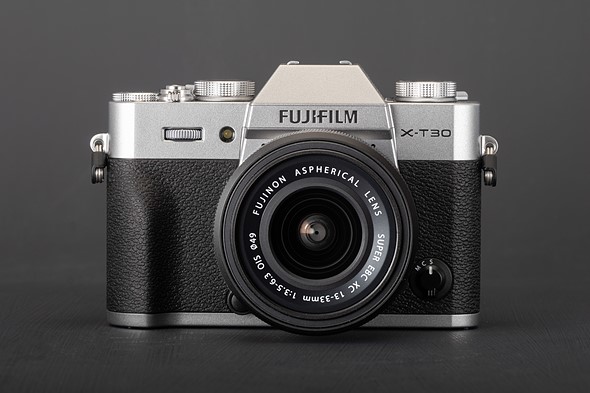
The Fujifilm X-T30 III is the company’s latest entry-level, SLR-shaped mirrorless camera, with its latest color mode recipes and autofocus.
Key specifications
- 26MP X-Trans APS-C BSI CMOS sensor
- Film simulation dial with recipe positions
- Tilt up/down rear screen
- 2.36M dot EVF
- 4K/60 video with 1.18x crop, 6.2K/30 full-sensor capture
- 315 shot-per-charge battery life, 425 in power saving mode
The X-T30 III is available at a recommended price of $999. There is also the option to buy the camera with a new, unusually wide, 13-33mm F3.5-6.3 OIS zoom lens, which will cost around $1150.
Index
- What’s new?
- What is it?
- How it compares
- Body and handling
- Image Quality
- Autofocus
- Video
- In Use
- The Auto Experience
- Conclusion
- Sample gallery
- Specifications
- Press release
What’s new?
 |
| The Film Simulation dial on the camera’s shoulder has three custom positions that can be assigned to film simulations or the simulation-and-parameter-tweak combinations known as ‘recipes.’ |
The X-T30 III, as the name implies, is an iterative update of the existing X-T30 II. It gains the latest Fujifilm processor, which brings subject recognition autofocus. This brings it into line with the X-M5 and X-T50.
It also gains a Film Simulation dial, instead of the drive mode dial on the previous X-T30 models. Like the more expensive X-E5, the three custom positions on the dial can be set up to store ‘recipes’: sets of JPEG processing settings that modify the behavior of an underlying film simulation.
The more powerful processor also brings a boost in the video features, with 60fps 4K video options (with a 1.18x crop) and the option to shoot using the whole sensor in 6.2K resolution at up to 30fps.
Finally, the X-T30 III becomes the first model to be offered with a new 13-33mm F3.5-5.6 stabilized kit zoom. This offers an unusually wide 20-50mm equivalent range, which is likely to be a welcome capability for photographers whose previous experience has mainly been with the wide-angle cameras on smartphones.
What is it?
 |
| The X-T30 III maintains the classic-SLR looks of the X-T series. |
The X-T30 III plays the same role in the lineup as its predecessor did: the least expensive SLR-shaped camera in the Fujifilm range. Like the Mark II and the X-M5, it’s built around an unstabilized 26MP BSI CMOS sensor. It’s an APS-C-sized chip with Fujifilm’s proprietary X-Trans filter pattern in front of it. This was originally designed to reduce visible errors in images, but increasingly just seems to make the files a little trickier to process.
The X-T30 III offers a decent set of features: it’ll shoot moderately quickly, captures good quality video and offers a range of subject-recognition AF modes, making it quick and easy to focus on common subject types. It also has a switch to jump quickly to its Auto mode that tries to select the appropriate scene mode and settings for whatever you point it at. It’s also somewhat unusual in still offering a small pop-up flash.
The standout feature of the X-T30 III, in common with the rest of the Fujifilm range, is the provision of its film simulation color modes, giving you a selection of (mostly) well-judged, attractive color responses for your images. The Mk III puts these at your fingertips by providing a dedicated dial, making it easy to experiment with the different looks it offers.
How it compares
The X-T30 III is one of Fujifilm’s entry-level models. The viewfinder means it’s a little more expensive than the rangefinder-style X-M5, but it has a list price lower than that of the image-stabilized X-S20. We’ll include the X-S20 as the most affordable stabilized APS-C camera.
In terms of rivals, the Nikon Z50II is probably the most like-for-like competitor, with Canon’s EOS R10 also offering similar specs for similar money. We’re omitting the distinctly elderly Sony a6400 as it only shoots 8-bit video and doesn’t have such extensive subject recognition AF. The OM System lineup either offers the OM-D E-M10 IV for less money or the OM-5 II for more, both are built around smaller but stabilized sensors. The OM-5 II is the least expensive mirrorless camera to offer an ‘IP’ rating for its weather sealing.
| Fujifilm X-T30 III | Nikon Z50II | Canon EOS R10 | Fujifilm X-S20 | |
|---|---|---|---|---|
| MSRP | $1000, $1150 w/ 13-33mm |
$1010, $1150 w/ 16-50mm |
$1100, $1250 w/ 18-45mm |
$1500, $1600 w/ 15-45mm |
| Resolution | 26MP | 21MP | 24MP | 26MP |
| Stabilization | Lens only | Lens only | Lens only | In-body (up to 7EV) |
| Flash, ISO 100 |
GN 5 | GN 7 | GN 6 | GN 5 |
| Cont. burst rate | 8fps Mech 20fps Elec |
11fps Mech 15fps Elec |
15fps Mech 23fps Elec |
8fps Mech 20fps Elec |
| EVF | 2.36M dots 0.62x mag |
2.36M dots 0.67x mag |
2.36M dots 0.59x mag |
2.36M dot 0.62x mag |
| Rear screen | 1.62 dots 3.0″ Tilt up/down |
1.04M dots 3.2″ Fully-artic. |
1.04M dots 3.0″ Fully-artic. |
1.84 dots 3.0″ Fully-artic. |
| Video options | 6.2K/30 open gate 4K/60 1.18x crop 4K/30 full-width |
4K/60 1.44x crop 4K/30 full-width |
4K/60 1.6x crops 4K/30 full-width |
6.2K/30 open gate 4K/60 1.18x crop 4K/30 full-width |
| Mic / ‘phones? | 2.5mm / Via USB adapter | Yes / Yes | Yes / No | Yes / Yes |
| Battery life rating | 315 | 220 EVF / 230 LCD | 210 EVF / 350 LCD | 750 |
| Dimensions | 118 x 83 x 47mm | 127 x 97 x 67mm | 123 x 88 x 83mm | 128 x 85 x 65mm |
| Weight | 378g | 550g | 429g | 491g |
In spec terms, there’s not much to choose between these models. What the chart can’t show is that the Nikon probably has the best autofocus tracking performance here, with the Canon a very close second (it’s a little less dependable in video mode). This is still something of a weakness for the Fujifilm, though its subject-recognition modes do well.
Both the Canon and Nikon handle better than the Fujifilm, having fewer, but in our experience, better laid-out controls that are harder to operate accidentally. The Fujifilm’s Auto switch will be handy for some users and anyone looking for a camera to grow into is more likely to find the lenses they want in the X mount, but the offerings for Canon and Nikon are (finally) improving, so it’s worth investigating whether the lenses you think you might want are available for each system, before picking a camera body.
The X-T30 III is also the smallest camera here and offers a wider array of attractive color modes than its rivals. There’s also the option of that unusually wide kit zoom.
Body and handling
 |
| The X-T30 II offers plenty of hands-on control, including two clickable command dials, an exposure comp dial and an AF joystick, but these have all been fitted into a small space. |
The body of the X-T30 III is essentially the same as the one from previous X-T30 models, meaning it’s slightly smaller than the X-T50 and lighter. A ridge down the front of the camera and a protruding bump on the back means it fits firmly in the hand, and feels secure thanks to the tactile rubber coating, front and rear.
The X-T30 III has a fair degree of external control, including six buttons that can be customized and four swipeable directions on the rear touch screen. It also has two well-positioned clickable command dials, a dedicated exposure comp dial and dedicated shutter speed dial, as well as that film simulation dial.
There’s also a joystick for positioning the AF point or navigating the menus and flick switches under two of the dials to activate the flash and to engage full Auto mode.
While we’re pretty impressed, overall with this level of direct and customizable control, we find it’s perhaps a little overwhelming on a body this small. If you have larger fingers, or don’t know what all the controls do, the X-T30 III risks being a bit of a handful. The clicking button under the front command dial can also be easy to inadvertently press when holding the camera or trying to change your settings, which, by default, will cycle it to control a different parameter than the one you were attempting to change. Of course, you can customize it to perform only a single function to avoid that problem.
 |
| The X-T30 III only has three ports on its right-hand side, but they offer a lot of functions. |
In terms of ports, the X-T30 III has a 2.5mm socket that serves double-duty as a remote control connector or a mic input. Most mics use a 3.5mm plug, so you’ll need an adapter to attach one. Below this there’s a USB socket that can be used for charging the camera, transferring data or connecting a pair of headphones, with the supplied adapter.
Finally, there’s the micro HDMI socket for outputting video or a Raw video data stream that can then be encoded by either a BlackMagic or Atomos external recorder to BRaw or ProRes Raw, respectively. This isn’t the obvious model to do that from, especially not given how delicate micro HDMI sockets can be, but it’s nice that Fujifilm hasn’t omitted a feature this hardware can support.
Battery
The X-T30 III uses the same 8.7 Wh NP-W126S battery as most of Fujifilm’s smaller cameras. It powers the camera to a rated value of 315 shots per charge, or 425 in ‘Economy’ mode. These numbers don’t reflect the number of shots you’ll get from the camera (getting twice the rated figure isn’t unusual, depending on your use of image review, flash or burst shooting), but they’re broadly comparable between cameras.
A figure of over 300 shots per charge is good for this class of camera and is likely to mean you can use it for a weekend of casual shooting without having to think about the battery. The battery can be recharged over USB.
Image Quality
 |
|
The X-T30 III has proven image quality. Fujifilm X-T30 III | Fujifilm XF 35mm F2 R WR | F5 | 1/680 sec | ISO 320 |
Fujifilm is using a very familiar sensor in the X-T30 III, as it’s the same one that appeared in the previous two iterations of the X-T30 (and older versions of the more expensive X-T series). It’s also the same sensor/processor combination that we saw in the Fujifilm X-M5.
None of this should be read as a complaint; the images from these cameras capture a good level of detail in Raw, with ever so slightly less than other 26MP models, potentially because of Fujifilm’s ‘X-Trans’ color filter design not playing particularly well with Adobe Camera Raw. We’ve also found that the JPEGs don’t always make fine details pop, a situation that gets slightly worse at higher ISOs when noise reduction is being applied, though you may not even notice either unless you’re zooming or cropping pretty far into your images.
If you’re a beginner photographer, though, don’t take those quibbles as a reason to avoid the X-T30 III. Its image quality and dynamic range are very good, and those factors won’t hold you back as you build your skills. Plus, you’ll benefit from Fujifilm’s well-considered JPEG colors, which have proven to be crowd-pleasing.
Shutter shock
One caveat to its otherwise good image quality is that, when paired with the 13-33mm kit lens, there can often be noticeable shutter shock in images taken with the lens zoomed in. This manifests as them looking not particularly sharp when you zoom in on them (though typically they’d still be acceptable to post on social media or to send to friends).
The easiest way to avoid this is to set the camera to use the electronic first curtain shutter, rather than the mechanical one, especially if you plan to shoot at our around 1/100 sec shutter speed, or if you’re letting the camera automatically set your shutter speed*. Fujifilm programs its more entry-level cameras to use a faster shutter speed in auto, which means that, when paired with lenses up to 35mm, the X-T30 III’s minimum shutter speed in several of its modes will be 1/100 sec; directly in the problematic range.
The issue also isn’t as prevalent with all lenses; we didn’t see much shutter shock when we tested it with the 35mm XF F2 lens, despite its focal length being very similar to the long end of the kit lens, where the issue is most noticeable.
* – Don’t be concerned by Fujifilm’s warning that the electronic first curtain shutter may “result in uneven exposure and loss of resolution in out-of-focus areas of the frame.” This only happens at very fast shutter speeds, when using wide apertures. You’re not ever likely to see the difference when using the standard zoom lens.
Autofocus
 |
| Fujifilm X-T30 III | Fujifilm XC 13-33mm F3.5-6.3 OIS | 30mm | F6.1 | 1/180 sec | ISO 320 Photo: Mitchell Clark |
The X-T30 III uses essentially the same autofocusing system as the rest of the company’s modern cameras. It lets you select what you want to focus on with a variety of AF area sizes, ranging from a single point if you’re trying to be precise, to the “Wide” mode that hands control of what to focus on over to the camera. If your camera is set to continuous focus mode, Wide mode is replaced by a tracking box, which will attempt to stick to whatever you put it over as it or the camera moves.
You can select the focus point using the joystick on the back of the camera or by tapping directly on your desired subject using the touchscreen. There’s also the option to use a customizable portion of the touchscreen as a joystick when your eye is up to the EVF.
 |
| The tracking option gives you a single-size box, but other modes offer more precision. |
The X-T30 III has AI-trained subject detection modes for humans, animals, birds, cars, motorcycles/bikes, airplanes and trains. The settings for human detection are separate from the other subject detection modes, which, in most cases, makes it a small hassle to switch between them. You’ll either have to set up two custom buttons or delve into the Q menu if you want to go from taking pictures of people to a non-human subject, or vice versa.
The subject recognition works no matter what your focus point selection method is, and it does a good job of only trying to focus on a recognized subject that’s directly under or quite close to your chosen AF point. That means you can leave subject detection on without worrying that the camera will try to jump to a recognized subject if it’s somewhere else in the scene.
This means you can use the AF area to specify which subject you want to focus on, if there’s more than one in the scene. This works less well in Wide mode, where the camera is choosing where to focus. It’ll only indicate a single recognized subject and, though you can use the joystick to pick another, you won’t really be sure of what it’ll select. Similarly, if the current subject turns away, the camera will leap to any other subject it can find. Generally, we find you can get more out of the subject recognition modes when you select an AF area to tell the camera what to focus on.
Autofocus performance
When it comes to photographing relatively static scenes, or subjects the camera can recognize, it does a decent job of getting things in focus, even if they’re moving at moderate speeds. For everyday photography, its single and continuous autofocus modes will likely get the job done.
If you’re trying to shoot sports, action or even particularly squirmy pets or children, though, the story may be a bit different. As with many of Fujifilm’s cameras, tracking non-recognized or fast-moving recognized subjects isn’t the X-T30 III’s strong suit. Even in decent lighting, there were several times when the tracking box would wander off the static subject we wanted it to stick to, and even if it does stick to something, it may slightly misjudge the focus or just not be able to keep up with a subject moving quickly towards it (though it’s hard to say how much of that is on the camera, versus on the lens).
While there were just as many times that it let us successfully use the track and recompose method, it’d be hard to trust it as much as a similar camera from Nikon, Canon or Sony in a situation where you only had a limited amount of time to get the shot. This isn’t to say that you can’t get the shots you want with the X-T30 III; you can, with a little bit of practice. It’s just that other cameras may make it a bit easier.
Video
 |
| The X-T30 III’s video specs are competitive, but there are other models better suited to video within the range. |
The X-T30 III gains all the video modes we’ve seen appear in this generation of 26MP Fujifilm models. In many respects, it’s a sensor better suited to video than the 40MP chip in their more expensive models, because it doesn’t have to read out so much data to produce its 4K footage.
The X-T30 II can capture full-sensor, ‘open gate’ footage at up to 30p in 6.2K resolution, or it can deliver 4K derived from this 6.2K resolution in more common aspect ratios. It can shoot 4K at up to 60p with a slight crop, and also has a “9:16 short movie mode” like the X-M5, allowing you to record vertical videos from a center crop of the sensor, without having to actually turn the camera on its side.
| Shooting mode | Crop | Rolling shutter rate |
|---|---|---|
| 6K open-gate | Full-width (3:2) | 24ms |
| 4K/24p | Full-width (16:9) | 21ms |
| 4K/60p | 1.18x | 16ms |
| 1080p/24p | Full-width (16:9) | 13ms |
Like the X-M5, it produces relatively detailed video in its 6K and 4K/24 modes, though you’ll lose a bit of quality if you shoot 4K above 30fps (with the trade-off being that you can change the playback framerate when you’re editing, producing slow-motion footage.) The camera lets you use its Film Simulations in video as well, including the subtle, attractive ‘Eterna’ Sim designed for video, and supports recording HDR video using the HLG tone curve. It also offers FLog and FLog2 tone curves. These trade convenience – you’ll have you edit your footage before it’s ready for viewing – for flexibility, giving you the ability to adjust lightness and tones when you’re editing, either manually, or with a pre-made LUT (Look Up Table) that lets you easily apply a specific look to your footage.
However, while the video specs are more than solid for this class of camera, the X-T30 III’s lack of image stabilization makes the X-T30 II a harder camera to shoot good footage with (a flaw shared by the rest of the cameras in this class that can be rectified with a tripod or gimbal). The kit zoom is stabilized, and you can add digital stabilization in the camera, but the X-S20 is probably the better choice if video is a significant interest to you. As well as stabilization, the X-S20 has standard 3.5mm mic and headphone sockets and is compatible with the accessory fan unit to extend recording times.
In Use
 |
|
Forgive the awkward grip on the camera; it’s mounted to a tripod whose stability was questionable. |
The X-T30 III’s big new trick over its predecessor is its ‘Film Simulation’ dial, which comes with an improved experience by supporting the ‘Film Recipes’ that are popular with many in the Fujifilm community. The dial gives you easy access to several of the company’s mostly well-judged color modes, encouraging you to change up the aesthetic of your photos while you’re shooting, rather than in editing.
The ‘Recipes’ system lets you customize it further, letting you modify those Simulations further with a selection of settings, and letting you save recipes to the three “FS” positions on the dial. This feature is taken directly from the higher-end X-E5, and its inclusion is just as welcome here.
While more experienced users may enjoy how many physical controls the X-T30 III has, we fear that it risks being overwhelming to beginner photographers. Not only is it covered with buttons and dials, but some are multi-function, and too easily activated. While more experienced shooters may notice that their easily pressed dial is suddenly doing something other than what they wanted, a beginner might be tricked into thinking they’re doing something wrong. And while we’re happy to have the joystick, its placement in the camera’s already tight grouping of controls means it’s not the easiest to reach, especially if you’re trying to use the camera one-handed.
It’s not a camera you have to think long and hard about bringing with you
One last small annoyance: rather than being near the center of the camera, the tripod socket has been put as close to the battery / SD card slot compartment as it could be. That means that, no matter how small your tripod plate is, you’ll have to remove it if you want to get to your storage or battery. The camera’s use of a 10Gbps USB-C port means it’s less likely that you’ll need to do that, as you can quickly offload images from it or charge it, but it still would’ve been nice to have the option to open the flap without taking off your tripod plate.
It is worth noting, though, that this decision could be mostly due to the camera’s compact size. It’s just a touch smaller than the higher-end X-T50, which means it’s just as easy to carry around, or to throw in your bag on a whim. That’s especially true if you’re using the collapsing kit lens, which makes its footprint even smaller. While it’d be a stretch to call it pocketable, it’s not a camera you have to think long and hard about bringing with you.
The Auto Experience
 |
| Flipping the Auto switch puts the camera in charge of most of the settings, but doesn’t take away your creative control. |
The X-T30 III’s Auto mode, easily accessible by a switch on the top plate, is a useful provision for beginners who won’t have the experience to know which settings are best to use in every situation. We found that it typically used reasonable settings and didn’t feel too limiting: it still allows shooting in Raw + JPEG, and gives you control over settings like the focus point, Film Simulation, exposure compensation, and whether to use the flash or not. This means the X-T30 III offers some of the ease of shooting with a phone, while still retaining the engagement of using a dedicated camera.
The camera attempts to recognize what you’re trying to take a picture of, and in what conditions
Part of what makes it work is that the camera attempts to recognize what you’re trying to take a picture of, and in what conditions (e.g., backlit portrait, fast-moving animal, etc), and set its exposure parameters and dynamic range settings accordingly. You can also manually specify what you’re shooting to have the camera tune its settings to be more appropriate, with dedicated modes for shooting portraits, landscapes, sports and more.
The autofocus also works a bit differently in Auto mode. Rather than making you manually select between human recognition or other kinds of subject recognition, it uses an automatic subject detection mode that you don’t have access to in the traditional shooting modes, which tries to detect any of its recognized subject types in the scene, including humans. While it does a good job of showing which subject it’s selecting, it still doesn’t make it obvious if it’s recognizing multiple subjects that you can switch between.
Another complaint around Auto mode is that, if you set an ISO setting in the standard mode, and then switch to Auto, it retains that setting, which could leave the camera fighting to get a proper exposure. While it’s nice that you have control over ISO in Auto, it’d probably be best for it to initially switch to auto ISO mode.
Conclusion
By Mitchell Clark
| Pros | Cons |
|---|---|
|
|
Overall, the X-T30 III is a solid option for beginners looking to start with photography, or for those who feel like the lack of interchangeable lenses on their phone is holding them back. Paired with its kit lens, it offers a range of focal lengths that people will likely already be familiar with, but with enough image quality to stand out from most smartphone snaps (though you can get even more out of its sensor by switching to a nicer lens).
While the shooting experience might be overwhelming at first – there are a lot of buttons, dials and switches – the camera offers the escape hatch of a well-considered Auto mode that lets you focus on composition, without taking away all your creative freedom. And when you’re ready for it, you can customize the buttons and dials to act in a way that works for you, though it would be nice if they were set up a little more sensibly out of the box.
 |
Speaking of creative freedom, the Film Simulation dial and its support for quickly switching between the “Recipes” often shared by the Fujifilm community is a useful tool for getting the look you want straight out of camera. While you could achieve everything it’s doing with a Raw file and editing software, the latter requires the knowledge of how to use it and, often, a subscription or up-front payment that you may not be ready to commit to.
It’s a solid option for beginners, and should grow with you
The X-T30 III isn’t a perfect camera, though. It’s unfortunate that you have to manually work around the shutter shock issue to get maximum image quality with the kit lens, and its autofocus system isn’t the easiest or the most confidence-inspiring. You’ll have to practice a fair bit with it to get results that other cameras let you achieve out of the box.
Ultimately, it’s a combination of these factors that keeps this camera from getting a Gold award. But it’s still a solid option for beginners, and should be able to grow with you wherever your photography journey takes you, in part thanks to the near-endless selection of lenses that you can pair with it. For that, it earns our Silver award.
Scoring
Scoring is relative only to the other cameras in the same category. Click here to learn about what these numbers mean.
|
Fujifilm X-T30 III
Category: Mid Range Interchangeable Lens Camera / DSLR
|
|
Build quality
Ergonomics & handling
Features
Metering & focus accuracy
Image quality (raw)
Image quality (jpeg)
Low light / high ISO performance
Viewfinder / screen rating
Performance
Movie / video mode
Connectivity
Value
|
PoorExcellent
|
||||
|
Conclusion
The X-T30 III isn't the overall most capable camera in the category, but its style, mostly well-judged kit lens and capable Auto mode make it a good pick for beginners.
|
|||||
|
|||||
|
|||||
RegularScoreCompareWidget({“mainElementId”:”scoringWidget”,”mainProduct”:”fujifilm_xt30iii”,”scoringSchema”:{“id”:”SLRs”,”variables”:[{“id”:”BuildQuality”},{“id”:”ErgonomicsAndHandling”},{“id”:”Features”},{“id”:”MeteringAndFocusAccuracy”},{“id”:”QualityRaw”},{“id”:”QualityJpeg”},{“id”:”LowLightHighISO”},{“id”:”ViewfinderScreenRating”},{“id”:”Optics”},{“id”:”Performance”},{“id”:”Movie”},{“id”:”Connectivity”},{“id”:”Value”}],”categories”:[{“id”:”EntryLevel”,”label”:”Entry Level Interchangeable Lens Camera / DSLR”,”shortLabel”:”Entry Level”},{“id”:”MidRange”,”label”:”Mid Range Interchangeable Lens Camera / DSLR”,”shortLabel”:”Mid Level”},{“id”:”EntryLevelFullFrame”,”label”:”Entry Level Full Frame Camera”,”shortLabel”:”Entry Level Full Frame”},{“id”:”MidRangeFullFrame”,”label”:”Mid Range Full Frame Camera”,”shortLabel”:”Mid Range Full Frame”},{“id”:”SemiProfessional”,”label”:”Semi-professional Interchangeable Lens Camera / DSLR”,”shortLabel”:”Semi-professional”},{“id”:”SemiProfessionalFullFrame”,”label”:”Semi-professional Full Frame Camera”,”shortLabel”:”Semi-professional Full Frame”},{“id”:”Professional”,”label”:” Professional Interchangeable Lens Camera / DSLR”,”shortLabel”:”Professional”},{“id”:”LargeSensorCompactEntry”,”label”:”Entry Level Large Sensor Compact Camera”,”shortLabel”:”Entry Level Large Sensor Compact”},{“id”:”LargeSensorCompactEnthusiast”,”label”:”Enthusiast Large Sensor Compact Camera”,”shortLabel”:”Enthusiast Large Sensor Compact”},{“id”:”VideoCamera”,”label”:”Video Camera”,”shortLabel”:”Video Camera”}]},”helpText”:”Choose one or more cameras from the drop-down menu, then roll your mouse over the names to see how their scores compare to the camera on review.”})
Compared to its peers
Nikon’s Z50II has better autofocus than the Fujifilm X-T30 III, which could be important if you think your photography journey will lead you to shooting sports and action. It’s also likely a better pick for video, thanks to its standard ports for headphones and microphones. However, while Nikon has slowly been improving its APS-C lens lineup, there still aren’t nearly as many options as there are for X mount, and the company exerts stricter control over what lenses are allowed to exist for Z mount.
The story is very similar for the Canon EOS R10, though its video capabilities are closer to the X-T30 III’s. As with Nikon, Canon exerts more control than Fujifilm over what lenses can be made for its lens mount and produces far fewer first-party options. However, its autofocus will perform better than Fujifilm’s, and its ergonomics (though probably not its looks) will be preferable to some.
By virtue of its stabilized sensor and price, the Fujifilm X-S20 represents a step up from the rest of the cameras we’re comparing. Its image quality and autofocus will be virtually identical to the X-T30 III’s, and while it offers the same Film Simulations, it doesn’t make it quite as easy to get to them, nor does it make adopting recipes so simple. The IBIS system, fully articulating screen and full headphone / microphone jacks make it a much more capable video tool, despite it having otherwise very similar specs.
Sample gallery
Please do not reproduce any of these images on a website or any newsletter/magazine without prior permission (see our copyright page). We make the originals available for private users to download to their own machines for personal examination or printing (in conjunction with this review); we do so in good faith, so please don’t abuse it.
Production samples
Pre-production samples
About the Author