The age of America as the global brain magnet may be ending
| Photo Credit:
DANA EDWARDS
Is the world, and specifically the US, about to tumble into the Thucydides’ Trap? It’s starting to look that way as Washington gazes fearfully at the Chinese dragon making one aggressive move after another in the East.
First, what exactly is the Thucydides’ Trap? It’s when a superpower finds itself facing a rising challenger. In ancient Greece, Sparta, the militaristic city-state, was unnerved by the rise of Athens, with its philosophers, thinkers and growing military strength. This escalated into the brutal Peloponnesian War.
In the modern context, we’re talking about the US crossing swords with China. Right now, drones, planes and ships aren’t about to open fire on each other. But in this 21st-century version of the Thucydides’ Trap, the US has launched a full-scale trade war on China, and the rest of the world’s caught in the crossfire. “Eccentric” is the politest word for US actions since Donald Trump’s re-election. Slapping 30 per-cent tariffs on all EU and Canadian imports is draconian and has those allies scrambling for a Plan B that excludes the US.
Turn to the energy sector, where the contrast with China is particularly stark. China is reckoned to be building 74 per cent of the world’s solar and wind energy. In contrast, Trump’s slashed tax credits for renewables, calling them “expensive and unreliable energy sources.” His energy secretary, Chris Wright, threw in the startling observation that there are “pluses and minuses to global warming.” China is also streets ahead in electric vehicles, where Trump has cut subsidies, leaving his old buddy Elon Musk out in the cold.
Look at other sectors where China is catching up with the West. It’s pushing ahead in AI-driven drug discovery, filing almost as many patents as the US.
Democrats this week accused Trump of “ceding global leadership to China.” That’s an unquestionably valid charge. The US is pulling away from the world and making moves like closing USAID. China, meanwhile, is extending railway lines and initiating projects across Africa and South America.
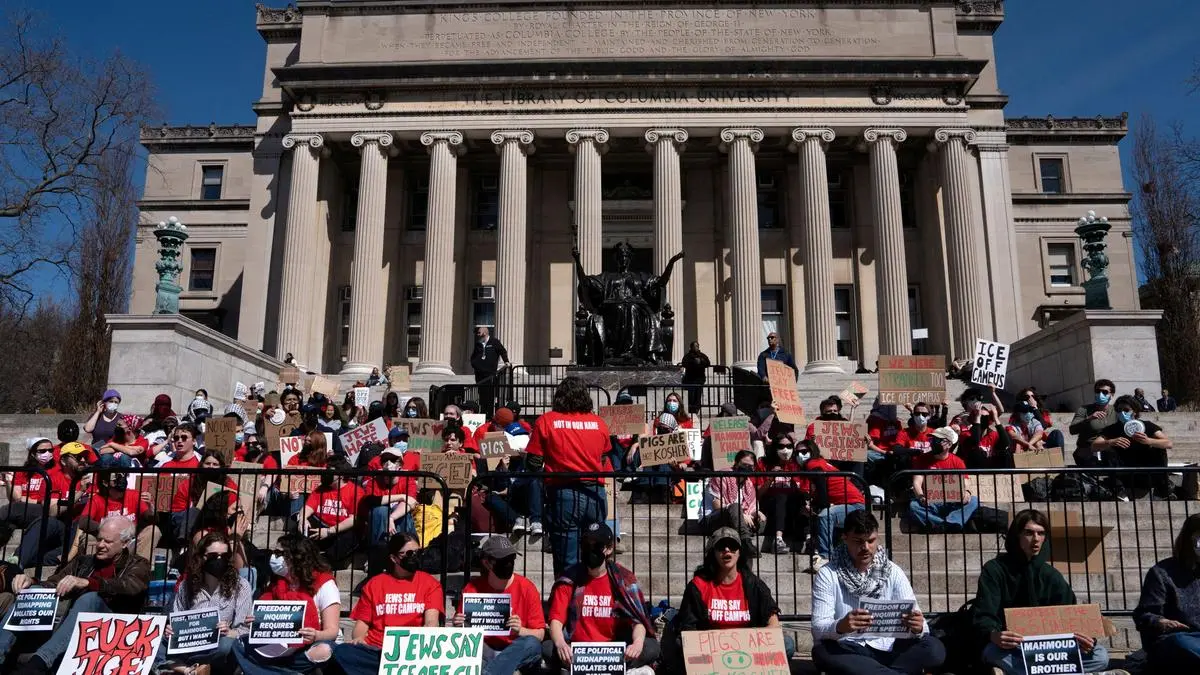
Then there’s Trump’s attack on universities and foreign students, once the backbone of America’s innovation engine. For decades, the brightest minds from India, China and elsewhere flocked to the US for its world-class education and promise of opportunity. Now, they’re feeling like unwelcome guests. Visa delays, a hostile political atmosphere and ICE raids have already caused Indian student applications to tumble.
It’s more than a crackdown on immigration. It’s a retreat from the very idea of knowledge acquisition. American universities, once the world’s envy, are being battered not just by funding cuts but by ideological suspicion of science and expertise. At a time when China is opening new research institutes, poaching international talent and pouring money into cutting-edge fields like AI, the US is pulling up the drawbridge.
And it’s not just about students. Skilled immigrants, from tech workers to researchers, face tougher entry. Washington’s message is clear: the age of America as the global brain magnet may be ending. For a country that rose to dominance by attracting the best minds of every generation, it’s a dangerous reversal and one China appears all too ready to capitalise on.
Cross to China, where Australian Prime Minister Anthony Albanese is putting Plan B into action. Leading a high-powered trade delegation, he said Australia had to build relations with its largest trading partner, sparking speculation about “the death of the Quad.”
In a tricky spot
Where does all this leave India? Quite simply, in a very tricky spot. We have a 3,000 km border to defend with China. And though relations appear to be improving, there are constant uncomfortable moments.
Foreign Minister S Jaishankar has just made his first trip to China since the Galwan clash. But that hasn’t stopped Beijing from making a pointed statement about the Dalai Lama’s successor.
As for our relations with the US, while the public optics remain friendly, the reality is always up and down. Trade talks have dragged on and Trump has been busy sweet-talking Pakistan. The US may be the land of values we cherish, but India’s learning to watch its back.
It would always be wrong to underestimate the US. In the 1980s, it looked like Japan would overtake it. Then the Silicon Valley stars brought America roaring back. But that comeback was powered by openness to talent, ideas and to the world.
This time, it’s not just a matter of innovation. It’s about whether America still believes in the values that made it a superpower. If the answer’s no, it won’t be China that traps the US in the Thucydides’ spiral. It will be the US that walks into it, eyes wide shut.
Published on July 16, 2025
About the Author