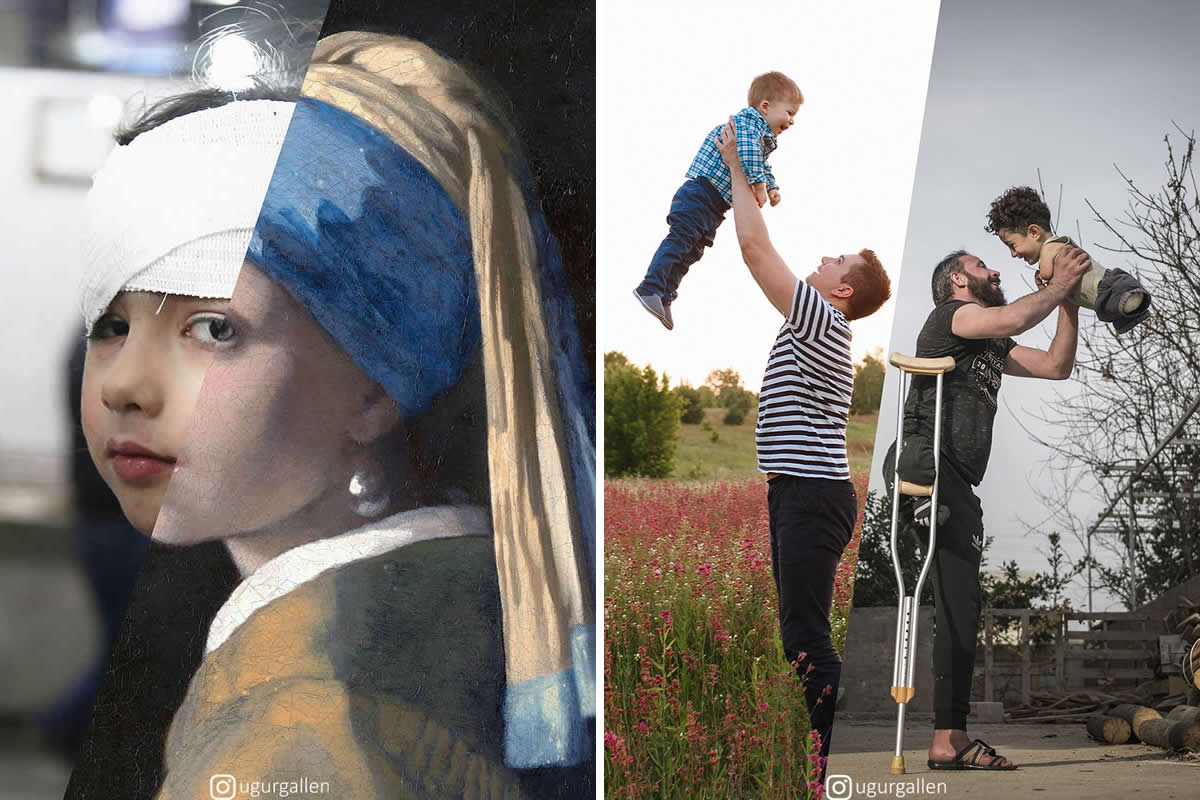
Istanbul-based artist Ugur Gallenkuscreates art that hits you right in the heart. His work is all about contrast, juxtaposing two very different worlds. In his digital collages, you’ll see snapshots of comfort and luxury alongside scenes of war, hunger, and hardship. It’s a jarring combination, and that’s exactly what he wants: to make you stop and really feel the difference.
His series, often called Parallel Universes, really makes you think because it reflects the world we live in. While someone enjoys a quiet coffee, someone else is fleeing for their life. He uses images from places like Afghanistan, Syria, Iraq, and more recently Palestine, Ukraine, and Yemen, matching them with scenes of everyday comfort. The result is shocking, sometimes uncomfortable, and you simply can’t look away.
Gallenkuş’s journey into art began in 2015, moved by the heartbreaking photo of Alan Kurdi, a Syrian child whose story touched millions. That image changed everything for him. Since then, he’s shared his message worldwide, working with organizations such as the United Nations Development Programme and Médecins Sans Frontières, using his art to raise awareness and inspire action.
Whether his work is shown in European galleries, online exhibitions, or even launched into space, his message remains clear: we share this world, but our realities can be worlds apart. Ignoring that isn’t an option.
You can find Ugur Gallenkus on the web:
#1. Syria War

Photo Credits: Mehmet Aslan
“Father Munzir and his son Mustafa as refugees in southern Turkey, near the border with Syria. January 2021. The story of Munzir and Mustafa is a representation of several war crimes committed during the Syrian civil war, mostly involving the use of chemical weapons and indiscriminate bombing of civilian areas. Munzir lost his right leg when a bomb exploded while he was walking through a market in Syria in 2014. His son, Mustafa, was born without limbs due to a disorder caused by medication his mother, Zeynep, had to take after being made ill by a deadly gas attack during the Syrian Civil War.”
#2. Afghanistan War

Photo Credits: Andrew Quilty
“Rabia poses in the International Committee of the Red Cross’s orthopedic center on her first day wearing a prosthetic. Asked if she could stand without crutches, Rabia let them fall to the ground. #Jalalabad, #Afghanistan. August 26, 2018.”
#3. Iraq War

Photo Credits: Paula Bronstein
“Ali Nassar Fadil, 4 years old, lies in a ward at the Italian Red Cross hospital, on April 13, 2004, after losing his left arm and leg 5 days ago from a blast injury by U.S forces who shot from the air killing his grandfather and 9 others in Fallujah, Iraq.”
#4. Afghanistan War

Photo Credits: Steve McCurry
“A doctor with his Afghan patient in a Red Cross hospital in Peshawar, Pakistan in 1985.”
#5. Afghanistan War

Photo Credits: Noorullah Shirzada
Children bear brutal cost of endless war. As 10 children from the same family were walking to school last year, they came across an unexploded mortar bomb. A common sight in Afghanistan, where war still rages between the Taliban and US-backed national forces. Not realising what it was or the dangers it posed, the curious kids picked up the device and took it to show to an aunt. And then it exploded. Three children and the older relative were killed, and the remaining seven lost at least one limb each.
During the war in Afghanistan (2001–present), over 31,000 civilian deaths due to war-related violence have been documented; 29,900 civilians have been wounded. Over 111,000 Afghans, including civilians, soldiers and militants, are estimated to have been killed in the conflict. These numbers do not include those who have died in Pakistan.”
#6. Afghanistan War

Photo Credits: Steve McCurry
“Two Afghan patients in a Red Cross hospital in Peshawar, Pakistan, find friendship and common interests as the man read to the boy. 1985. The use of landmines is controversial because of their potential as indiscriminate weapons. They can remain dangerous many years after a conflict and war have ended, harming civilians and the economy. Approximately 80% of landmine casualties are civilian, with children as the most affected age group. Most killings occur in times of peace. Approximately 80% of landmine casualties are civilian, with children as the most affected age group. Most killings occur in times of peace.”
#7. Vietnam War

Photo Credits: Roland Schmid
The family of Nguyen Van Bong (1962), his wife Tran Thi Gai (1964), and her daughter Nguyen Thi Tutet (1993). The father was exposed to Agent Orange during the war, and the two daughters are brain damaged and require full care. Visiting families affected by Agent Orange. Da Nang, Vietnam. May 18, 2022.
#8. Ukraine War

Photo Credits: Emilio Morenatti
“Followed by their mother Natasha, Yarik Stepanenko, 11, pushes his twin sister Yana’s wheelchair along a corridor of a public hospital in Lviv, Ukraine, Thursday, May 12, 2022. On April 8, a missile struck the train station in the eastern city of Kramatorsk where Yana, Yarik and their mother Natasha were planning to catch an evacuation train heading west and, they hoped, to safety. Yana lost two legs, one just above the ankle, the other higher up her shin. Natasha lost her left leg below the knee. Yarik, left at the station in the chaos of the attack, was uninjured and has been reunited with his mother and sister.”
#9. Gaza Strip, Palestine War

Photo Credits: Samar Abu Elouf
“Gazal Bakr in the hallway of the Doha apartment complex where she now lives. Gazal was wounded on November 10th, 2023, when, as her family fled Gaza City’s Al-Shifa hospital, shrapnel pierced her left calf. To stop the bleeding, a doctor, who had no access to antiseptic or anesthesia, heated the blade of a kitchen knife and cauterized the wound. Within days, the gash ran with pus and began to smell.
By mid-December 2023, when Gazal’s family arrived at Nasser Medical Center—then Gaza’s largest functioning health-care facility—gangrene had set in, necessitating amputation at the hip. On December 17th 2023, a projectile hit the children’s ward of Nasser. Gazal and her mother watched it enter their room, decapitating Gazal’s twelve-year-old roommate and causing the ceiling to collapse. (Multiple news reports have described the event as an Israeli attack. The I.D.F. claimed the incident could have been caused by a Hamas mortar or the remnant of an Israeli flare.) Gazal and her mother managed to crawl out of the rubble.”
#10. Gaza Strip, Palestine War

Photo Credits: Samar Abu Elouf
“Mahmoud Ajjour, nine-year-old, who was injured during an Israeli attack on Gaza City in March 2024, finds refuge and medical help in Doha, Qatar. As his family fled an Israeli assault, Mahmoud turned back to urge others onward. An explosion severed one of his arms and mutilated the other. The family were evacuated to Qatar where, after medical treatment, Mahmoud is learning to use his feet to play games on his phone, write, and open doors. Aside from that, he needs special assistance for most daily activities, such as eating and dressing. Mahmoud’s dream is simple: he wants to get prosthetics and live his life as any other child.”
#11. War

Photo Credits: Özge Elif Kızıl / Anadolu Agency
“Volunteers help a refugee man and baby, hoping to cross into Europe, arrive on the shore of Greece’s Lesbos Island after crossing the Aegean Sea from Turkey to Greece. November 29, 2015.”
#12. Gaza Strip, Palestine War

Photo Credits: Wissam Nassar
“A Palestinian man holds a girl, whom medics said was injured in an Israeli shelling at a U.N-run school sheltering Palestinian refugees, at a hospital in the northern Gaza Strip in 2014.”
#13. Afghanistan War

Photo Credits: Paula Bronstein
“At the Emergency hospital Najiba holds her nephew Shabir, age 2, who was injured from a bomb blast which killed his sister in Kabul on March 29, 2016.”
#14. Syria War

Photo Credits: Amer almohibany
“A wounded Syrian boy covered in blood waits to receive treatment at a make-shift hospital in Kafr Batna in the besieged Eastern Ghouta region on the outskirts of the capital Damascus following Syrian government bombardments on February 21, 2018.”
#15. Gaza Strip, Palestine War

Photo Credits: Anas Baba
“A man holds the hand of Maria al-Gazali, a Palestinian baby, as her body lies on a stretcher at a hospital in Beit Lahia, in northern Gaza Strip on May 5, 2019.”
#16. Syria War

Photo Credits: Ammar Suleiman
“Ammar Suleiman is a Syrian photographer, cinematographer, and multimedia journalist. He is known for his work documenting the devastating effects of the war in Syria.”
#17. Syria War

Photo Credits: Ammar Suleiman
“Ammar Suleiman is a Syrian photographer, cinematographer, and multimedia journalist. He is known for his work documenting the devastating effects of the war in Syria.”
FAQs:
Who is Uğur Gallenkuş?
Uğur Gallenkuş is a digital collage artist from Istanbul who fuses images of war and peace. His art throws global inequality and human suffering into sharp relief. Through exhibitions and collaborations around the world, his bold storytelling cuts through both online and offline, earning him wide recognition.
What is the “Parallel Universes” concept?
“Parallel Universes” is Gallenkuş’s signature style, blending two starkly different worlds into a single, striking image. It reveals how comfort and chaos exist side by side, forcing us to face the unfair divide between peace and turmoil.
What inspired Gallenkuş to start creating collage art?
The heartbreaking photo of Alan Kurdi, the Syrian child whose death shocked the world, changed everything for Gallenkuş. That moment inspired him to leave corporate life and turn his art into a call for awareness and compassion.
What themes are common in his artwork?
Gallenkuş’s art dives into war, displacement, inequality, consumerism, and human rights. By weaving together privilege and hardship, he creates jarring contrasts that make us question our world and our role in it.
How does his art contribute to global awareness?
Working with organizations such as the UNDP and Doctors Without Borders, Gallenkuş uses his art to spotlight humanitarian crises. His powerful images spark dialogue, urge action, and bring global issues like healthcare, social justice, and human rights into sharp focus.
Related Articles:
About the Author