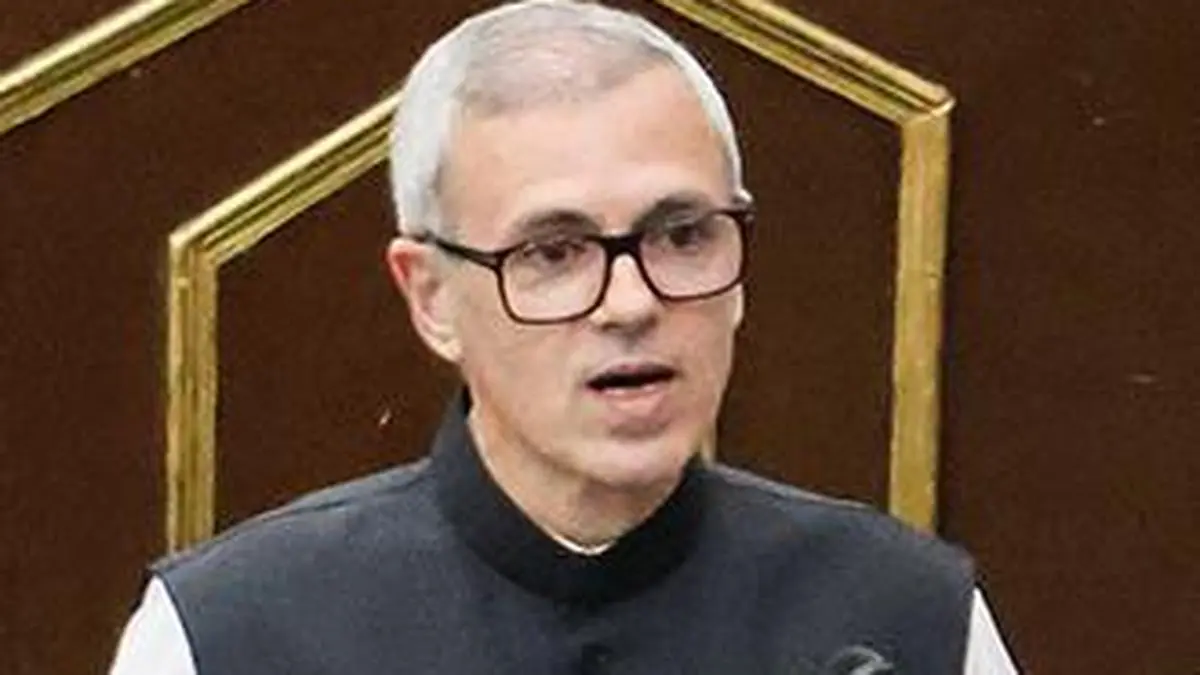
File picture: Jammu & Kashmir CM Omar Abdullah
| Photo Credit:
ANI
The International Monetary Fund’s approval for a fresh tranche of support to Pakistan has not gone down well in India. While Jammu & Kashmir Chief Minister Omar Abdullah questioned the rationale behind the move, principal Opposition party Congress said India has “chickened out” by abstaining from voting on the proposal.
“I’m not sure how the “International Community” thinks the current tension in the subcontinent will be de-escalated when the IMF essentially reimburses Pakistan for all the ordnance it is using to devastate Poonch, Rajouri, Uri, Tangdhar & so many other places,” Abdullah said in a social media post.
In a post senior Congress leader Jairam Ramesh said that on April 29th, his party had demanded that India vote against the IMF loan to Pakistan, which was considered on Friday by its Executive Board. India has only abstained from the vote. “The Modi Government has chickened out. A strong NO would have sent a powerful signal,” he said.
On Friday, the Executive Board of the International Monetary Fund (IMF) completed the first review of Pakistan’s economic reform programme supported by the Extended Fund Facility (EFF) arrangement. This decision allows for an immediate disbursement of around $1 billion (SDR 760 million), bringing total disbursements under the arrangement to about $2.1 billion (SDR 1.52 billion). In addition, the IMF Executive Board approved the authorities’ request for an arrangement under the Resilience and Sustainability Facility (RSF), with access to about $1.4 billion (SDR 1 billion).
As a member of the Executive Board, India did record its strong objection, but abstained from the voting as, according to officials, there is no provision of formal ‘NO’ in the voting process. The Board consists of 25 Directors who represent member countries or groups of countries. Unlike in the United Nations, where each country has one vote, IMF voting power reflects the economic size of each member. For instance, countries like the US have a 16.49 per cent voting share, followed by Japan and China with 6.41 and 6.08, respectively. India has a share of over 2 per cent.
During the meeting India said: “While the concern that fungible inflows from international financial institutions like IMF could be misused for military and state sponsored cross-border terrorist purposes resonated with several member countries, the IMF response is circumscribed by procedural and technical formalities. This is a serious gap highlighting the urgent need to ensure that moral values are given appropriate consideration in the procedures followed by global financial institutions,” a Finance Ministry statement said. India was represented by World Bank executive director Parameswaran Iyer, who has been given temporary charge as the government cut short the tenure of Executive Director K V Subramanian.
Last September, the Executive Board of the IMF approved a 37-month Extended Arrangement under the EFF for Pakistan in the amount of SDR 5,320 million (or around $7 billion). While there was an immediate disbursement of $1 billion, a Friday meeting was called to review the funding programme for Pakistan.
During the meeting, India raised concerns over the efficacy of IMF programmes in the case of Pakistan, given its poor track record, and also on the possibility of misuse of debt financing funds for state-sponsored cross-border terrorism. It said that Pakistan has been a prolonged borrower from the IMF, with a very poor track record of implementation and adherence to the IMF’s programme conditions. In the 35 years since 1989, Pakistan has had disbursements from the IMF in 28 years. In the last 5 years since 2019, there have been 4 IMF programmes.
Published on May 10, 2025
About the Author