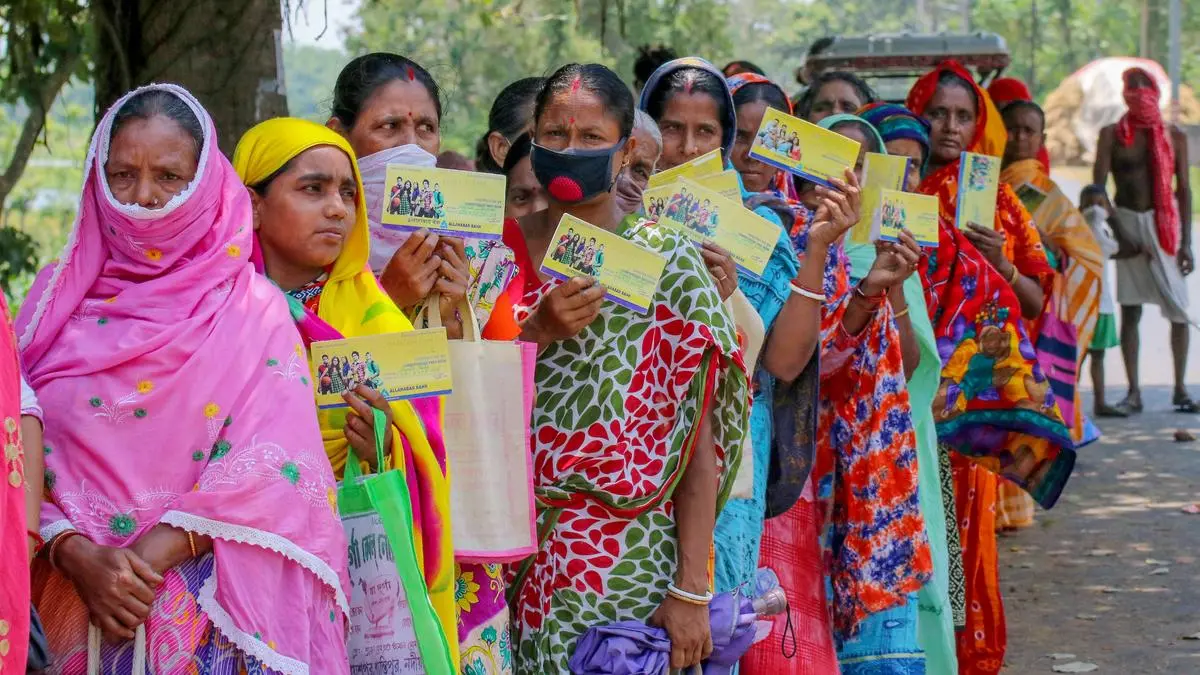

With near-universal access to banking services now within reach, the challenge ahead lies in deepening financial inclusion
| Photo Credit:
–
Financial inclusion is the sine qua non of sustainable development. This is evident from the fact that seven of the 17 United Nations Sustainable Development Goals (SDGs) of 2030 identify it as a key enabler for achieving inclusive growth worldwide. The first step towards financial inclusion starts with banking the unbanked, as account ownership acts as a gateway to the formal banking system.
Financial inclusion, therefore, requires deliberate and structured policy interventions to extend banking services to those historically left out. To turn the principle into practice, Prime Minister Modi’s maiden address from the ramparts of Red Fort announced the Pradhan Mantri Jan Dhan Yojana (PMJDY), a scheme which was formally launched on August 28, 2014, under the National Mission on Financial Inclusion.
The vision of the mission was encapsulated in its slogan, “Mera Khaata, Bhagya Vidhata” (My Account, Fortune Maker). It sought to bring the poor and historically marginalised into the economic mainstream, enabling access to the formal banking system and ensuring they became stakeholders and beneficiaries of India’s growth story. Jan Dhan accounts allowed beneficiaries to open zero-balance and zero-charge accounts with minimal paperwork and simplified KYC/e-KYC requirements. They also provided additional features such as RuPay debit cards with in-built accident insurance cover of ₹2 lakh, and an overdraft facility of up to ₹10,000.
Since its launch, PMJDY has achieved unprecedented success. A 2024 Economic & Political Weekly paper notes that “India’s account ownership marked a historical growth rate of 26 percentage points between 2014 and 2017, which can be attributed to the world’s largest financial inclusion drive — PMJDY. This is nearly four times more than the global account growth (6.57) and three times more than the developing countries (7.27) during the same period.”
As of August 8, 2025, over 56 crore Jan Dhan accounts have been opened, of which, nearly 67 per cent have been in bank branches located in rural and semi-urban centres. The scheme has also demonstrably bridged gender disparities: over 55 per cent of PMJDY accounts — more than 31 crore — are held by women. Further, Jan Dhan accounts have become critical conduits for social security enrolments, with recent parliamentary data showing that roughly one-third of all enrolments under the Pradhan Mantri Jeevan Jyoti Bima Yojana (PMJJBY) and Pradhan Mantri Suraksha Bima Yojana (PMSBY) are linked to PMJDY.
Transparency enhanced
PMJDY has also emerged as a cornerstone of India’s digital public infrastructure. It has democratised access to payments and enabled millions to enter the digital economy. By underpinning the success of Direct Benefit Transfer(DBT), PMJDY has enhanced transparency, minimised leakages in welfare delivery, and strengthened trust in government schemes. Together with Aadhaar and mobile connectivity, the Jan Dhan-Aadhaar-Mobile (JAM) trinity has been instrumental in the widespread adoption of digital payments across India.
The synergy between Jan Dhan accounts and the Unified Payments Interface (UPI) has empowered small and marginal entrepreneurs within the informal sector by giving them access to formal financial channels for conducting business. Recent NPCI data shows that nearly half of all UPI transactions by volume are in the categories of food and groceries — sectors dominated by micro-entrepreneurs — highlighting how financial inclusion and digital payments together have transformed day-to-day commerce at the grassroots.
The impact has gone beyond financial access, generating significant positive externalities. A 2022 study, ‘Access to Banking, Savings and Consumption Smoothing in Rural India’, found that access to banking improves consumption smoothing by alleviating savings constraints — an issue as critical for the poor as credit constraints. Similarly, a 2021 SBI Research report observed that higher PMJDY balances were associated with declines in crime rates, and that States with higher account penetration reported statistically significant reductions in the consumption of intoxicants such as alcohol and tobacco.
The challenges ahead
With near-universal access to banking services now within reach, the challenge ahead lies in deepening financial inclusion. Encouragingly, RBI’s Financial Inclusion Index reflects consistent progress in this direction. The composite index — capturing information across three dimensions of financial inclusion: access (35 per cent), usage (45 per cent), and quality (20 per cent) — has steadily risen since its launch in 2021, reaching 67 as of March 2024. On this scale, where 0 represents complete exclusion and 100 full inclusion, India’s steady upward trajectory underscores the deepening and broadening of financial inclusion nationwide.
PM Jan Dhan Yojana’s success in introducing the unbanked to the economic mainstream is not a one-time achievement, but a stepping-stone on the longer journey towards deeper financial inclusion and unlocking the second-order effects that can truly transform lives, livelihoods, and the pathways to shared prosperity.
The writer is Chief Economic Adviser, Ministry of Finance
Published on August 27, 2025
About the Author