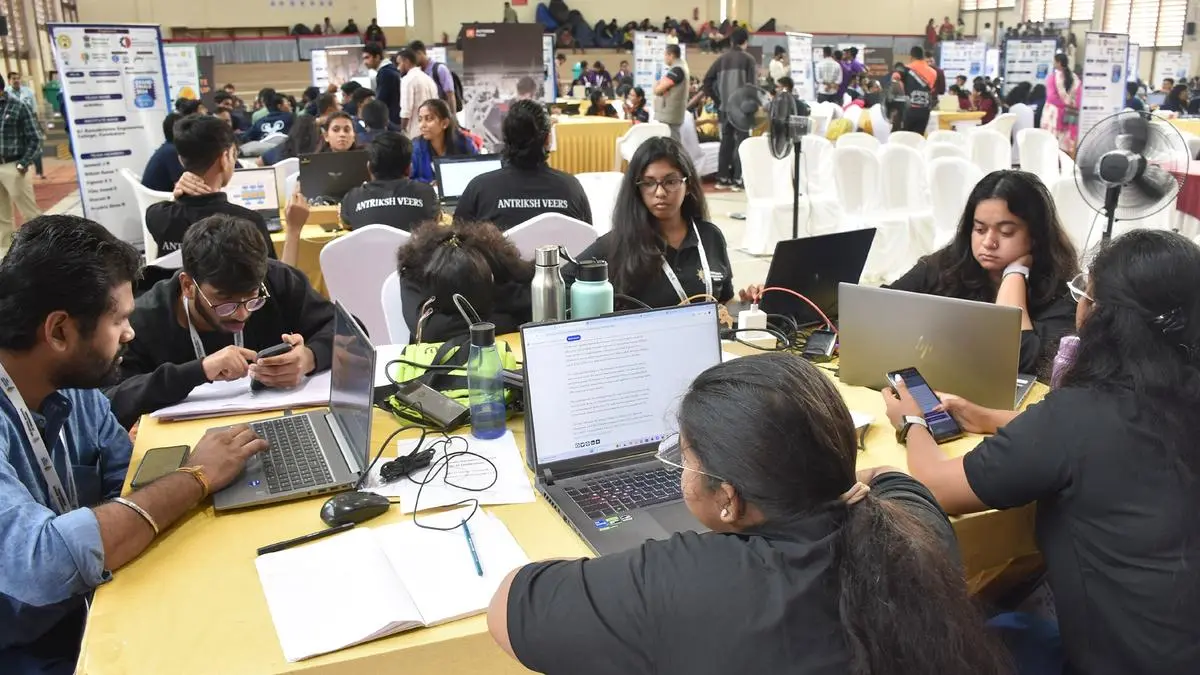

The role of universities in shaping this future is important for the socio-economic growth of Bharat
| Photo Credit:
SRIRAM MA
Traditionally, wooden anniversary is symbolic of a relationship that has strength, stability, and deep roots. Similarly, the new National Education Policy (NEP) 2020, which celebrates it wooden anniversary today, is strengthened by intent, stabilised by action and deepened by rootedness. As the country cerebrates NEP 2020’s fifth anniversary, let us take a panoramic view of the past five years to provide a telescopic view of the coming years.
Enduring value
NEP has lasting value because of its far-reaching impact that is futuristic. Bharat is a civilisational continuum. No other country can match its civilisational heritage and richness. A knowledge society is a comprehensive framework of people and institutions guided by ethos and values. India’s G-20 Presidency saw the announcement of the future of the world as a family — Vasudaiva Kutumbakam — through Prime Minister Narendra Modi’s clarion call for One Earth, One Family, One Future.
The role of universities in shaping this future is important and for the socio-economic growth of Bharat. Universities form the foundational asset for a knowledge society and economy — creation, validation and transmission as emphasised by basic research, applied research, teaching and learning. The Bharatiya Gnana Parampara — Indian Knowledge System (IKS) — is deeply rooted in undatable knowledge sources.
Knowledge source is four-dimensional as per Vedic slokas — 25 per cent from teacher (directed learning), 25 per cent from developing own intelligence (self-learning), 25 per cent from peer group (team learning) and 25 per cent from experience (experiential learning).
NEP 2020 also covers these four dimensions in a comprehensive manner for universities, through its flagship objectives and principles. Directed learning is maximised through faculty development, curriculum development, creative pedagogy, etc.
Students’ self-learning is facilitated through various curriculum flexibility, research opportunities, SWAYAM, etc. Peer learning is integrated through activity-based education, collaborative learning, PAIRed learning, etc. And experiential learning is triggered through various upskilling, reskilling, immersive learning and faculty fellowship, among others.
NEP also prepares students through holistic education built on character and values that embody humility, worthiness, enrichment and happiness.
NEP lays stress on environment and sustainability just as our Sanathana Dharma reveres the Pancha Boothas (five sacred elements) — air, water, fire, space and earth — the environmental assets of the world. The stress on IKS traces Bharat’s deeply rooted assets that are predominantly spiritual, cultural, ethnic and enriched with various forms of civilisational richness.
IKS is a perfect bridge between modern studies and ancient wisdom and is an attempt to reconnect with our ancient glory using Bharatiya Bhasha to the maximum.
Promotes research
Also, NEP 2020 triggers emerging streams of education and research through a multi-disciplinary approach — Digital India, Skill India, quantum, AI, nanotechnology, defence, robotics and automation, etc. STEM education blended with non-STEM, with a variety of multi-disciplinary options supported by ANRF, SPARC, GIAN, etc., make it aspirational.
The present narrative on Bharat is undergoing a paradigm shift due to PM Modi’s Viksit Bharat @ 2047, and NEP 2020 is its education partner.
All stakeholders concerned need to play a significant role to celebrate India’s past, celebrate present narratives to fix distortions, and to calibrate the future. In short, the wood anniversary of NEP 2020 is a goldmine to harvest.
The writer is Vice-Chancellor and Tata Sons Chair Professor of Management, SASTRA Deemed University. Views are personal
Published on July 29, 2025
About the Author