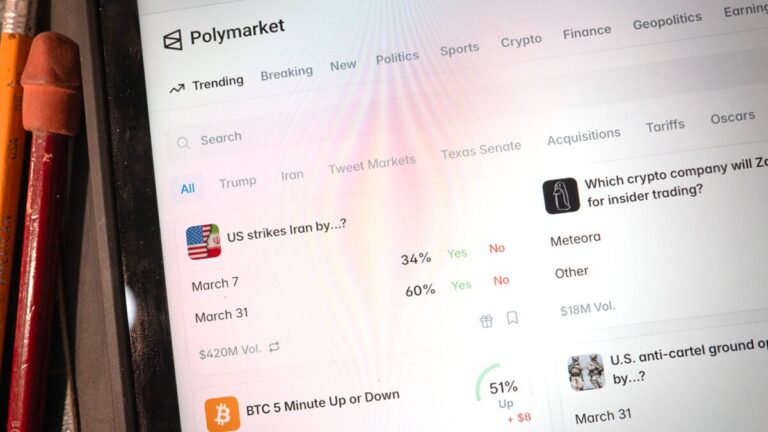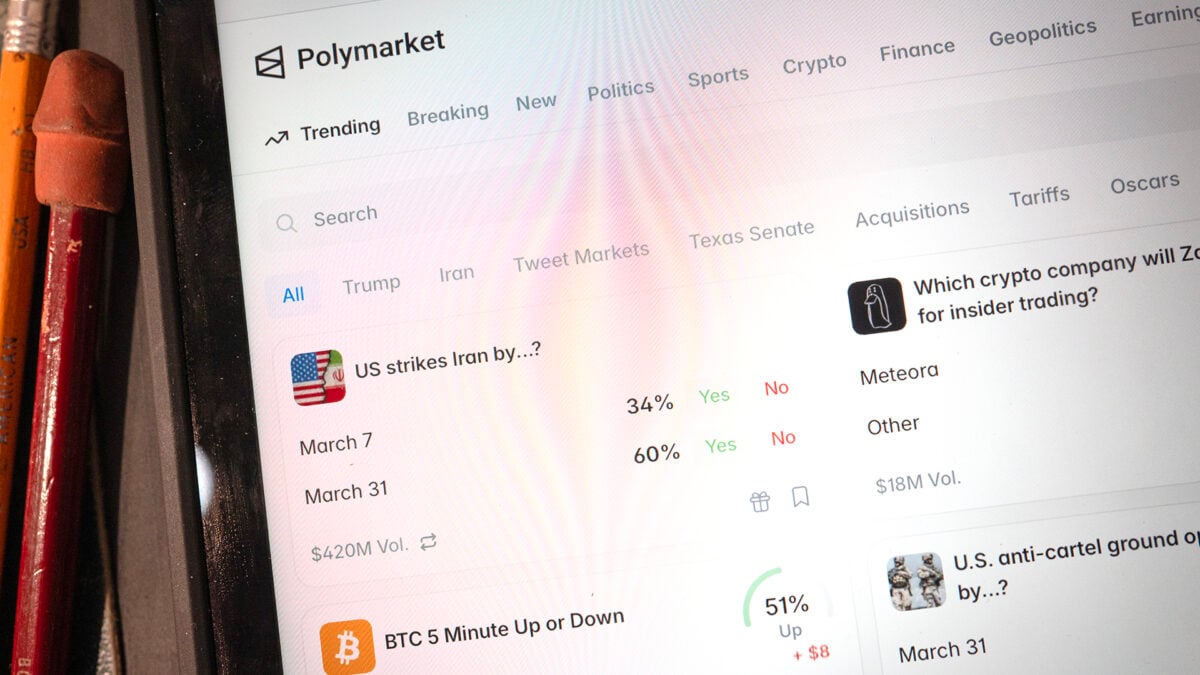

On Sunday, X user @itslirrato (bio: “chief prediction markets enjoyer”) noticed some suspicious activity on Polymarket. Ten accounts with no clear relationship other than their activity were all betting on a ceasefire in Iran by the end of the month. In total, they’ve bet $160,000, and if their prediction is correct, their winnings will total $1.04 million.
Just tracked a highly suspicious group of 10 Polymarket wallets
They’re trying to stay under the radar by splitting into small positions, but I caught their pattern
– All in on YES for US x Iran ceasefire by Mar 31/Apr 15
– $7K to $24K in positions per wallet
– 99% of positions… pic.twitter.com/yliIb4TzyF— Lirratø (@itslirrato) March 22, 2026
According to Gordon Gottsegen of MarketWatch, one of those accounts, named NOTHINGEVERFRICKINGHAPPENS, is the most suspicious of all. The account was created at the end of February, and got its start by placing two similar bets—one for $11,283, and one for $7,600—on U.S. strikes against Iran by February 28 and by March first. U.S. strikes started on February 28, so both bets paid out to the tune of $85,000 total.
And now, see for yourself: NOTHINGEVERFRICKINGHAPPENS has two more active bets: $16,582.45 if “US x Iran ceasefire by March 31?” resolves to “yes,” and $24,265.52 if “US x Iran ceasefire by April 15?” resolves to “yes.”
This account, by the way, has no other bets aside from these four on the topic of the Iran war.
Shortly after a bipartisan pair of Senators, Adam Schiff and John Curtis, introduced something called the “Prediction Markets are Gambling Act,” on Monday—which would ban sports betting on Polymarket and its competitor Kalshi—both sites announced new actions to police for insider trading.
According to the Associated Press, Polymarket, for its part, changed its rules such that users—athletes, most notably—are banned from trading on contracts if they may have the ability to influence whether or not the event occurs, or if they have confidential knowledge of the relevant event. While most obviously designed for, say, professional boxers, the new policy could impact government officials and private contractors with security clearance.
About the Author