Every year, the world stops for a moment to let photographs speak for themselves. The winners of the World Press Photo awards 2026 have just been announced, and these images go beyond simply showing what happened—they pull you right into the story. This is more than photojournalism; it’s truth, captured and delivered straight from the heart of real events.
This year, 3,747 photographers from 141 countries submitted a staggering 57,376 images. The entries ranged from powerful scenes in war zones to subtle, everyday moments that reveal our shared humanity. Photographers competed in categories like Singles, Stories, and Long-Term Projects, representing every corner of the globe—from Africa and Asia-Pacific to Europe and the Americas. The quality and diversity this year were truly exceptional.
What sets these winning photographs apart is their honesty. There are no gimmicks—just genuine people, true stories, and real emotions. Some images capture the turmoil and urgency of crisis, while others focus on small, personal moments that stay with you long after you’ve seen them. This balance is what makes the collection so memorable.
These photographs do more than document the world—they confront it. They urge you to look more closely, to reflect, and sometimes to sit with discomfort. That’s the power of photography at its best: it doesn’t let you look away. It makes you pause and pay attention.
You can find more info:
1. North and Central America | Long-Term Project | Mexico, A Changing Climate by César Rodríguez

Photograph: César Rodríguez, Norwegian Red Cross, SNCA, The New York Times/World Press Photo 2026
“A tourist boat sits grounded after La Boca dam dropped to 8.5% capacity during the 2022 drought. Monterrey remains caught between extreme water scarcity and catastrophic, climate-driven flooding. Santiago, Nuevo León, 20 June 2022. Mexico is especially vulnerable to climate extremes, with 52% of its territory situated in arid or semi-arid zones. Over the last two decades, environmental disasters have internally displaced approximately 2.7 million people, a figure projected to reach up to 8 million by 2050”
2. Asia-Pacific and Oceania | Stories | Wedding in the Flood by Aaron Favila

Photograph: Aaron Favila, Associated Press/World Press Photo 2026
“The newlyweds share a kiss as guests cheer. The couple have been together for 10 years. According to Verdillo: ‘This is just one of the struggles that we’ve overcome.’ Malolos, Bulacan province, Philippines, 22 July 2025. When Typhoon Wipha hit the Philippines and flooded Barasoain Church, Jade Rick Verdillo and Jamaica Aguilar faced a difficult decision: should they cancel their wedding or proceed with the marriage? The couple carried on despite high waters, a testament to love and resilience in the face of severe weather.”
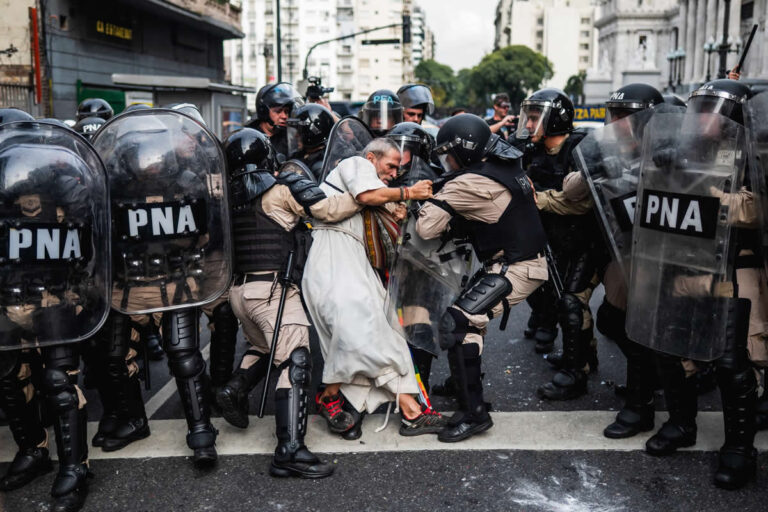
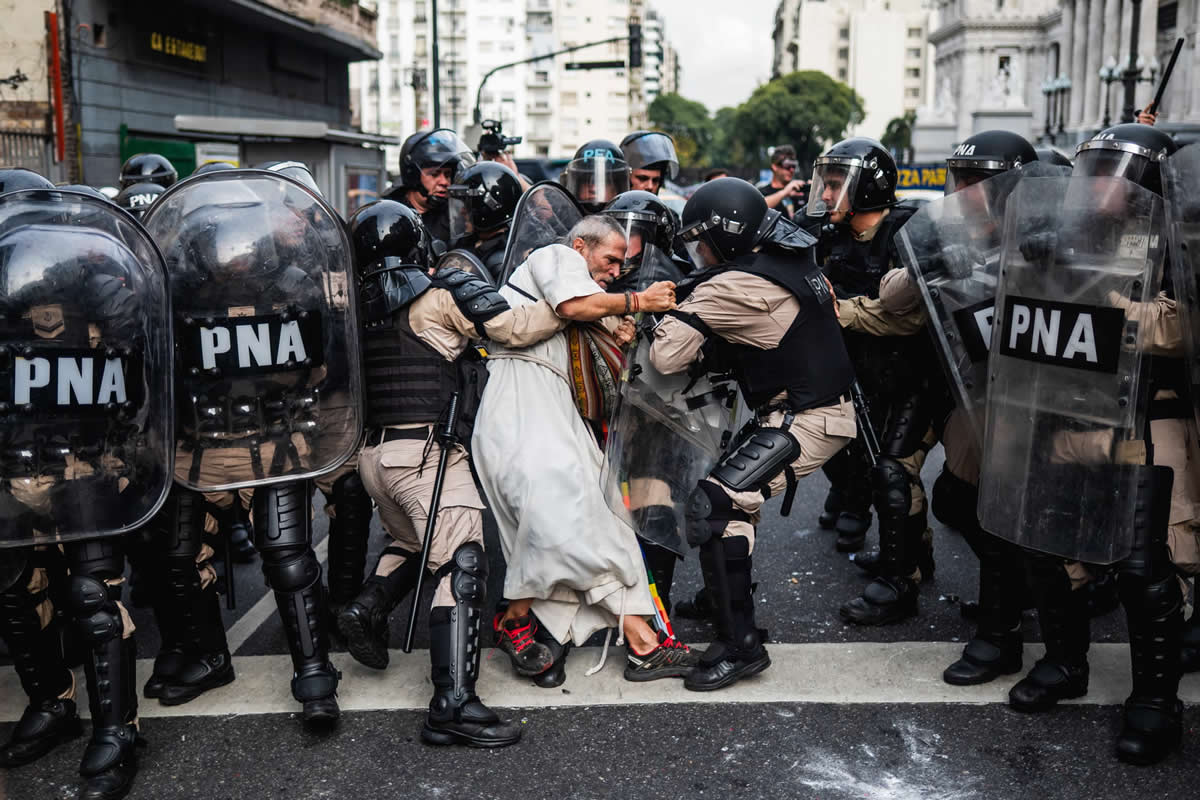
3. South America | Singles | Milei’s Argentina by Tadeo Bourbon

Photograph: Tadeo Bourbon, for Revista Mu/World Press Photo 2026
“Police detain Father Jorge ‘Chueco’ Romero during a pensioners’ protest. Members of the Option for the Poor clergy have joined weekly demonstrations against pension freezes and cuts to essential medical coverage. Buenos Aires, 14 May 2025. In Argentina, aggressive austerity measures aimed at curbing 200% inflation have plunged older people into a desperate struggle for survival. With the minimum pension hovering around $300 – below half the estimated basic cost of living – many retirees are forced to ration food and forgo essential medical treatments.”
4. Europe | Singles | Emma the Social Robot by Paula Hornickel

Photograph: Paula Hornickel/World Press Photo 2026
“Waltraud talks with Emma, a social robot that recognises faces and remembers past conversations. Though skeptical at first, Waltraud says she felt connected to Emma over time. Albershausen, 3 July 2025. Germany’s care homes are facing two crises: staff shortages and loneliness. One in five residents aged 80 and older describe themselves as severely lonely. This reality has prompted trials of social robots like Emma, developed by a Munich-based startup. Waltraud, a resident of Haus im Wiesengrund, had her doubts but over time formed a bond with Emma.”
5. South America | Stories | Those Who Carry the Dead by Eduardo Anizelli

Photograph: Eduardo Anizelli, Folha de S.Paulo/World Press Photo 2026
“Municipal workers wash away blood in São Lucas Square. Despite the unprecedented death toll and failure to apprehend key gang leaders, the state government declared the operation a success. Rio de Janeiro, Brazil, 29 October 2025. A massive police operation targeting the Comando Vermelho criminal syndicate unfolded in Rio’s Complexo do Alemão and Penha favelas. Deploying a record 2,500 local and military officers, the raid was the deadliest police operation in Brazilian history. Of the 122 people killed, the vast majority were Afro-Brazillians.”
6. Asia-Pacific and Oceania | Singles | A Desperate Plea by Tyrone Siu

Photograph: Tyrone Siu, Reuters/World Press Photo 2026
“Mr Wong cries out in anguish as fire engulfs the Tai Po housing complex he calls home. Moments earlier, he phoned his wife, who was trapped in the building, and they exchanged what would be their final words. Hong Kong, 26 November 2025. The fire at Wang Fuk Court housing complex claimed 168 lives, the city’s deadliest fire since 1948. While no official cause has been reported, investigations found bamboo scaffolding, construction netting, and flammable Styrofoam boards on windows acted as accelerants for the fire, trapping residents inside.”
7. North and Central America | Stories | Los Angeles on Fire by Ethan Swope

Photograph: Ethan Swope, for Associated Press/World Press Photo 2026
“The Palisades fire ravages a neighbourhood amid high winds. The Los Angeles blazes inflicted between $28bn (£21bn) and $53.8bn (£40bn) in property damage, disrupting thousands of local businesses. Los Angeles, California, United States, 7 January 2025. Severe drought and 100mph winds fuelled 14 devastating wildfires across LA, destroying over 18,000 buildings and displacing 200,000 residents. While officials reported 31 direct fatalities, public health studies estimate 440 excess deaths linked to toxic smoke and disrupted medical care.”
8. West, Central and South Asia | Stories | ‘I’m Afraid’: Afghan Women Face US Aid Cuts by Elise Blanchard

Photograph: Elise Blanchard, for Time/World Press Photo 2026
“Atifa assists in what she says will be her last delivery, having run out of medication and the means to continue, at the Malmastok Family Health House. Shahristan district, Daikundi province, 22 July 2025. In Afghanistan, US aid cuts have left pregnant women without access to care, forcing many to give birth at home in a country with one of the world’s highest maternal mortality rates, and leading to the suspension or closure of 422 health facilities nationwide, including small community clinics.”
9. Africa | Stories | Madagascar’s Gen Z Protests by Luis Tato

Photograph: Luis Tato, Agence France-Presse/World Press Photo 2026
“Protesters celebrate outside City Hall as members of the Capsat military unit ride on an armoured vehicle. Antananarivo, 11 October 2025. In September 2025, students began protesting across Madagascar over failing public services, corruption, and economic hardship. When the president, Andry Rajoelina, dissolved his government but refused to resign, demonstrations intensified. The Capsat unit defected to join the protesters, the same force that installed Rajoelina in a 2009 coup. Days later, the military seized power, promising elections within two years.”
10. South America | Stories | Manacillos: A Return to Life by Ever Andrés Mercado Puentes

Photograph: Ever Andrés Mercado Puentes/World Press Photo 2026
“People carry an exhausted Manacillo. Fiesta de los Manacillos is a traditional ritual enacted by the community during Holy Week. Tradition dictates Manacillos cannot sleep for the first 48 hours of the festival. Juntas, Buenaventura, Colombia, 19 April 2025. An Afro-descendant community deep in the Colombian Pacific rainforest, it is accessible only by a 10-hour boat journey up the Yurumanguí River. Settled by descendants of enslaved Africans brought in the 1700s, the community faces threats from illegal mining, logging and armed conflict.”
11. West, Central, and South Asia | Long-term Project | Hijacked Education by Diego Ibarra Sánchez

Photograph: Diego Ibarra Sánchez/World Press Photo 2026
“Hundreds of textbooks burned by IS extremists inside Hani Hakuf’s school. At least a quarter of Syrian schools have been damaged or destroyed. Al-Shaddadi, Syria, 11 April 2016. The UN estimates 85 million of the 234 million school-age children affected by conflict worldwide have no access to education at all. Schools are destroyed, teachers killed or forced to relocate, textbooks burned, and classrooms turned into barracks. Since 2011, the photographer has documented this crisis across nine countries.”
12. South America | Singles | A Territory of Hope by Priscila Ribeiro

Photograph: Priscila Ribeiro/World Press Photo 2026
“Sandra Mara Siqueira rests with her grandchildren, Micael, Davi, Ana Flávia and Vitória. Living in the Parque dos Lagos occupation since 2013, the family seeks land regularisation to guarantee access to basic infrastructure. Colombo, Paraná, Brazil, 15 November 2025. Millions of Brazilians lack safe and affordable housing, with a national shortage of 5.9m homes forcing over 16 million people into informal settlements. Parque dos Lagos is home to 200 families living without official access to water, sewage disposal or electricity.”
13. Africa | Stories | Sudan’s War: A Nation Trapped by Abdulmonam Eassa

Photograph: Abdulmonam Eassa, for Le Monde/World Press Photo 2026
“Soldiers pass through a damaged market in Sudan’s second most populous city, a site of continuous fighting since April 2023. Omdurman, 25 October 2024. After a 2019 revolution overthrew decades of dictatorship, Sudan’s democratic hopes were crushed by a military coup in 2021. Army and paramilitary forces turned on each other, beginning a war that has spiralled into one of the world’s worst humanitarian crises. Foreign powers continue to fuel the conflict with weapons, over 13 million people have been displaced, and at least 150,000 killed.”
14. Europe | Stories | Drone War by David Guttenfelder

Photograph: David Guttenfelder, The New York Times/World Press Photo 2026
“A soldier from Ukraine’s 93rd Brigade scans for Russian FPV drones while speeding through Kostiantynivka, a strategic gateway to Ukraine’s last major defensive belt in Donetsk. Ukraine, 19 June 2025. The battle against the Russian invasion is reshaping modern combat. Hobby drones are being repurposed into remote-controlled weapons, and mass-produced first-person-view (FPV) drones are piloted remotely with deadly precision. These developments have triggered an unrelenting drone arms race and turned vast areas of Ukraine into kill zones.”
15. Asia-Pacific and Oceania | Singles | Bondi Beach Terror Attack by Edwina Pickles

Photograph: Edwina Pickles, The Sydney Morning Herald/World Press Photo 2026
“An overwhelmed police officer leans over near the bodies of Boris and Sofia Gurman. During the Bondi Beach terror attack, the couple were killed while attempting to disarm one of the shooters. Sydney, Australia, 14 December 2025. During Bondi Beach’s Chanukah by the Sea, a community event celebrating the Jewish holiday, two armed men motivated by Islamic State ideology attacked participants, killing 15 people. The victims included 10-year-old Matilda and 87-year-old Ukrainian Holocaust survivor Alexander Kleytman.”
16. North and Central America | Singles | Portland Protests ICE by Jan Sonnenmair

Photograph: Jan Sonnenmair/World Press Photo 2026
“Officers from the Department of Homeland Security and other federal agencies clash with demonstrators outside an ICE processing centre. Portland, Oregon, US, 24 June 2025. In 2025, the Trump administration shifted its immigration enforcement from the border to the US interior, aiming for 3,000 arrests a day and abandoning protections for schools, hospitals, courthouses, and places of worship. Portland, which prohibits its own state and local law forces to cooperate with federal immigration enforcement, became a flashpoint for resistance.”
17. Europe | Stories | Burned Land by Brais Lorenzo

Photograph: Brais Lorenzo, EFE, Revista 5W, El País/World Press Photo 2026
“Two people run with a bucket of water to help fight a wildfire in Carballeda de Avia. Ourense, Galicia, Spain, 17 August 2025. In a record year for wildfires in Europe, over 200,000 hectares burned across Galicia during Spain’s worst fire season in about three decades. The increasingly severe fires in this region are attributed to drought and heat intensified by climate change, rural depopulation, and shortsighted forest management policies, including the widespread planting of highly flammable non-native species.”
18. Europe | Stories | Engla Louise by Sanna Sjöswärd

Photograph: Sanna Sjöswärd, for Corren/World Press Photo 2026
“Engla Louise celebrates her birthday on a day trip to Löfstad Castle with her father, Hans Ericsson. Norrköping, Sweden, 28 September 2025. A former dancer, Engla has lived with severe anorexia nervosa since she was 10 years old. At 46, she weighs less than 25 kilos and has been tube-fed since 2019. Researchers increasingly describe anorexia as a disease of both body and mind. Its causes are thought to involve neurobiological, genetic, and environmental factors. After decades of treatment, she is considered therapy-resistant and receives palliative care at home.”
19. Europe | Long-term Project | Extramuros by William Keo

Photograph: William Keo, La Bibliothèque Nationale de France, Die Zeit/World Press Photo 2026
“Mehdi, of Algerian origin and originally from the Bosquets housing project in Montfermeil, competes in a street fight organised by CanalPourss, a local initiative using boxing to reduce violence. Marseille, France, 27 July 2024. In the peripheral neighbourhoods of France’s banlieues, migrant families navigate postcolonial legacies, higher rates of unemployment, and structural inequality. France’s integration system requires migrants to culturally assimilate while prejudice persists, leaving communities caught between exclusion and belonging.”
20. North and Central America | Stories | ICE Arrests at New York Court by Carol Guzy

Photograph: Carol Guzy, ZUMA Press, iWitness, for Miami Herald/World Press Photo 2026
“A security guard breaks down while witnessing a family separation. Security personnel frequently find themselves caught between federal agents, desperate families, and protesters in the increasingly volatile courthouse environment. New York, 20 August 2025. In 2025, shifts in immigration policy transformed courthouses into focal points for deportation efforts by Immigration and Customs Enforcement. Masked agents detained undocumented migrants immediately following their hearings, often leading to traumatic family separations.”
21. West, Central, and South Asia | Stories | A Syrian City Rebuilds, Still Divided by Nicole Tung

Photograph: Nicole Tung, VII Photo, for The New York Times/World Press Photo 2026
“A group of day labourers prepare cement for mixing at a construction site next to destroyed buildings. Deir al-Zour, Syria, 21 August 2025. Long neglected by the Syrian state and one of the first cities to rise up in the 2011 revolution, Deir al-Zour endured years of siege, bombardment, and successive occupation by government forces, IS and Kurdish-led fighters. The conflict left around 75% of the city’s infrastructure damaged or destroyed.”
22. West, Central, and South Asia | Singles | Aid Emergency in Gaza by Saber Nuraldin

Photograph: Saber Nuraldin, EPA Images/World Press Photo 2026
“Palestinians climb onto an aid truck as it enters the Gaza Strip via the Zikim Crossing in an attempt to get flour, during what the Israeli military called a ‘tactical suspension’ in operations to allow humanitarian aid through. Northern Gaza Strip, 27 July 2025. In 2025, famine took hold amid what a UN commission has concluded is a genocide in Gaza, which Israel disputes. The UN reports that between 27 May and 31 July at least 1,373 Palestinians seeking food were killed at or near aid distribution sites.”
23. Asia-Pacific and Oceania | Long-term Project | Motherhood at 60 by Wu Fang

Photograph: Wu Fang/World Press Photo 2026
“Sheng Hailin combs her daughters’ hair before school. As the girls grew, Hailin faced the increasing challenge of managing their daily needs while navigating her own diminishing physical capabilities. Hefei, Anhui Province, China, 21 May 2018. After the death of her only child, retired doctor Hailin sought IVF and gave birth to twin girls Zhizhi and Huihui at the age of 60. A portrait of Sheng Hailing’s family over 15 years – only one of many shīdú, parents who have lost their only child born during China’s one-child policy era.”
24. Africa | Stories | Farīsāt: Gunpowder’s Daughters by Chantal Pinzi

Photograph: Chantal Pinzi, Panos Pictures/World Press Photo 2026
“Ghita Jhiate manages her unruly stallion. Long forbidden by her father to participate in Tbourida, she finally realised her dream of riding alongside pioneer Zahia Aboulait in 2025. Sidi Rahal, Morocco, 6 August 2025. Tbourida is a Unesco-recognised Moroccan equestrian tradition dating back to the 16th century. Troupes gallop in unison, firing rifles in a choreographed performance of cavalry warfare. Historically excluded, female riders have fought for inclusion since Morocco’s 2004 family code reforms strengthened women’s legal rights.”
25. South America | Long-term Project | The Human Cost of Agrotoxins by Pablo E. Piovano

Photograph: Pablo E. Piovano, Manuel Rivera-Ortiz Foundation, Philip Jones Griffiths Foundation, Lawen.doc/World Press Photo 2026
“Fabián Tomasi, a former agrochemical worker, suffered from severe toxic polyneuropathy and became a global face of the fight against agrotoxins, passing away in 2018. Entre Ríos, Argentina, 25 October 2016. In 1996, Argentina approved genetically modified, herbicide-resistant soybeans paired with glyphosate-based herbicides, a policy adopted without independent research. In three decades pesticide use increased from 40m to 580m litres annually. Today 60% of Argentina’s cultivated land is sprayed, affecting 14 million people.”
26. West, Central, and South Asia | Stories | Witnessing Gaza by Saher Alghorra

Photograph: Saher Alghorra, for The New York Times/World Press Photo 2026
“Palestinian detainees and prisoners arrive at Nasser hospital after being released from Israeli custody as part of the ceasefire agreement. Israel freed nearly 2,000 Palestinians. Khan Younis, Gaza Strip, 13 October 2025. In 2025, civilians in Gaza endured starvation, famine and relentless bombardment as the death toll surpassed 75,000 and Israeli authorities severely restricted the flow of humanitarian aid. A ceasefire agreement in October has yet to bring meaningful relief.”
27. Africa | Singles | Joburg ballet school by Ihsaan Haffejee

Photograph: Ihsaan Haffejee, for GroundUp/World Press Photo 2026
“Young dancers from the Joburg ballet school backstage at the Soweto Theatre during their year-end performance. Soweto, South Africa, 7 December 2025. In apartheid South Africa, ballet was the preserve of white culture, inaccessible to people of colour. Today, the Joburg ballet school offers subsidised training to children from historically disadvantaged backgrounds, with locations in Soweto, Alexandra and Braamfontein. Parents describe seeing their children learn ballet as something they never thought possible.”
28. Africa | Long-term Project | Moon Dust by Mohamed Mahdy

Photograph: Mohamed Mahdy, Arab Documentary Photography Program/World Press Photo 2026
“Awady, who was born with asthma, raises pigeons as a hobby. ‘Every day, I am afraid I won’t be able to play football again,’ he says. Alexandria, Egypt, 14 February 2018. More than 30,000 residents of Wadi el-Qamar, also known as Moon Valley, live less than 15 metres from a cement factory that fills their homes with toxic dust. Children are born with asthma. Families suffer from lung disease and irreversible respiratory damage. In 2016, the photographer – who lives nearby and has asthma himself – began documenting their stories and ongoing legal battles.”
29. Europe | Singles | Russian Attack on Kyiv by Evgeniy Maloletka

Photograph: Evgeniy Maloletka, Associated Press/World Press Photo 2026
“Valeria Syniuk sits near her badly damaged home. She was asleep when a Russian missile destroyed the building opposite hers. Ukraine, 24 April 2025. One of the deadliest attacks on Kyiv by Russia since the start of the invasion in 2022. Hours after international peace negotiations stalled, missiles and drones struck at least five residential neighbourhoods, killing 13 people and wounding 90. Russia’s intensifying air campaign continues to devastate life across the country, systematically targeting infrastructure, hospitals, and educational institutions.”
30. North and Central America | Stories | Tanner’s Song by Jahi Chikwendiu

Photograph: Jahi Chikwendiu, The Washington Post/World Press Photo 2026
“Shay and Tanner view sonogram images of their daughter during a prenatal checkup. Tanner’s last wish was to fight cancer long enough to see his baby. Provo, Utah, US, 15 April 2025. Diagnosed with Stage 4 colon cancer at age 25, Tanner Martin and his wife, Shay, raced to build a family despite a terminal prognosis. The final months of Tanner’s life culminated in the birth of AmyLou 41 days before his death, aged 30. People born in 1990 now face a 200-300% increased risk of some early-onset cancers compared to previous generations.”
31. Europe | Singles | Polar Bear on Sperm Whale by Roie Galitz

Photograph: Roie Galitz/World Press Photo 2026
“A female polar bear feeds on a sperm whale carcass in the polar pack ice north of the Norwegian archipelago, Svalbard. 82° North, International Waters, 8 July 2025. Polar bears are primarily seal predators, but as ice retreats in the summer and hunting becomes harder, they increasingly rely on opportunistic scavenging. Near Svalbard, the ice-free season has lengthened by 20 weeks in the last 30 years. Sperm whales typically avoid ice-covered polar waters, so this carcass was a rare sight.”
32. Asia-Pacific and Oceania | Stories | Scam Hub Under Siege by Jes Aznar

Photograph: Jes Aznar, for The New York Times/World Press Photo 2026
“Offices in Shunda Park were left in disarray after a surge of fighting between the Myanmar military and the opposition militia nearby. Some parts of the complex resembled professional executive suites; others trapped workers in a Sisyphean loop of 12-hour shifts. Min Let Pan, 5 December 2025. The Karen National Liberation Army captured Shunda Park, a massive cyber-scam compound in Myanmar’s Karen State. As the country’s civil war intensifies, lawless border regions have become hubs for a lucrative online scam industry.”
33. West, Central, and South Asia | Singles | Nepal’s Gen Z Uprising by Narendra Shrestha

Photograph: Narendra Shrestha, EPA Images/World Press Photo 2026
“Fire and smoke engulf Singha Durbar after protesters stormed and set the government complex alight during violent demonstrations. Kathmandu, 9 September 2025. A government ban of 26 social media platforms on 4 September was the breaking point for Nepal’s youth. Thousands took to the streets on 8 September. Within two days, 76 people were dead, most young demonstrators killed by police. Following the resignation of the prime minister, KP Sharma Oli, protesters stormed and set fire to the government complex.”
34. West, Central, and South Asia | Singles | A Daughter’s Grief in Kashmir by Yasir Iqbal

Photograph: Yasir Iqbal, Outlook India Magazine/World Press Photo 2026
“Sanam Bashir, 21, collapses with grief at her mother’s funeral. Nargis Begum, 45, died from shrapnel wounds after a mortar shell struck while the two were fleeing their home. Uri, Jammu and Kashmir, India, 9 May 2025. The Kashmir region has been contested between India and Pakistan since the 1947 partition of British India, a dispute that has fuelled decades of conflict. On 22 April 2025, an attack on tourists in Pahalgam killed 26 people. India blamed Pakistan-backed militant groups and responded with strikes on 7 May.”
FAQs:
What is the World Press Photo Contest?
The World Press Photo Contest is an internationally celebrated event that recognizes outstanding photojournalism and documentary photography. It brings together remarkable visual stories from all corners of the globe, shining a spotlight on significant social, political, and cultural events as seen through the eyes of professional photographers.
How many entries were submitted in 2026?
In 2026, 3,747 photographers from 141 countries sent in a total of 57,376 images. The large number of submissions shows just how important this contest is worldwide and highlights the rich variety of stories photographers are sharing today.
What categories are included in the competition?
The contest features three main categories: Singles, Stories, and Long-Term Projects. Each one offers a different way to tell a story—from a single striking photo to a series of images that unfold over time.
Why are World Press Photo images so impactful?
These photos are powerful because they capture real moments with honesty and emotion. Many of them shine a light on major world issues, human challenges, and unforgettable moments that help viewers connect with stories they might never see in their own lives.
Where can I view all the winning photos?
You can see all the winning photos from the 2026 World Press Photo contest on the official website. The site gives you access to every award-winning image, complete photo series, and background details about each photographer.
Related Articles:
About the Author